
Dify
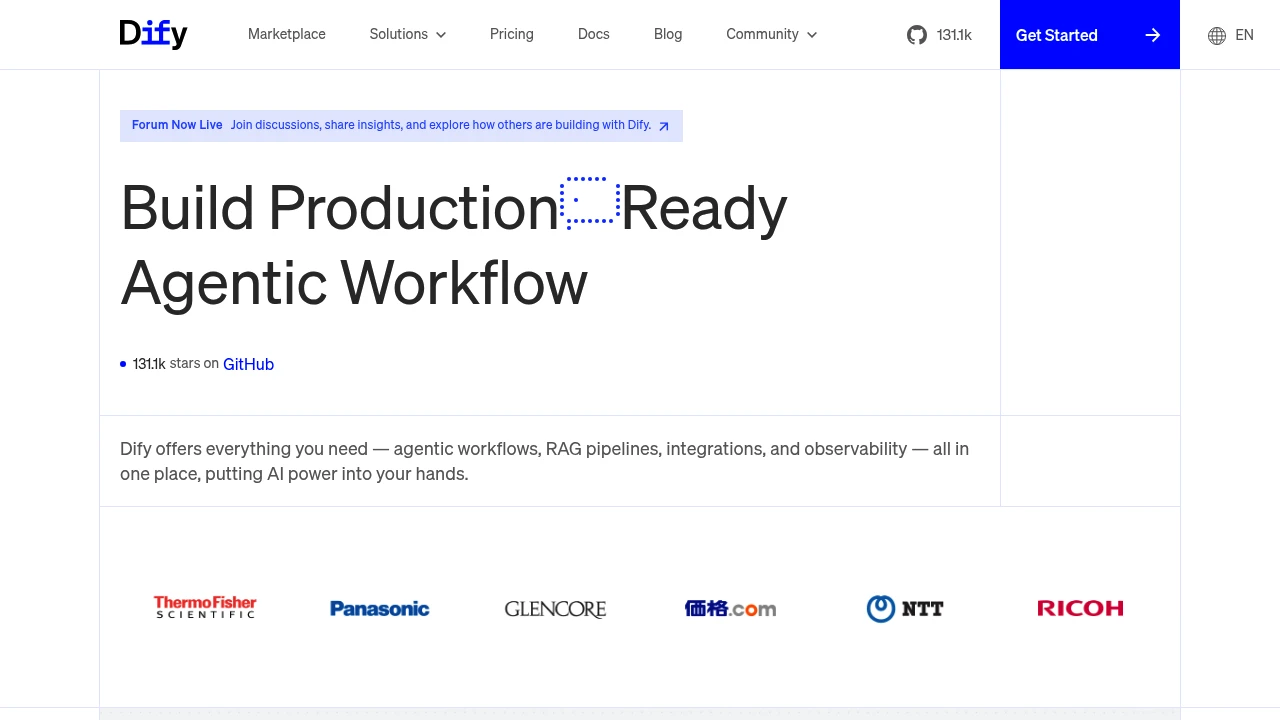
Dify is an open-source AI workflow builder with drag-and-drop design, multi-LLM integration, RAG pipelines, MCP protocol, and enterprise deployment for production-ready AI apps.
Summary
Dify is an open-source AI workflow platform that lets teams visually build, deploy, and manage autonomous agents, RAG pipelines, and AI apps. Ideal for rapid AI validation, multi-LLM integration, and enterprise-scale deployment.
What is Dify?
Dify is a no-code / low-code AI application development platform offering a drag-and-drop workflow editor, global LLM integration, RAG data processing, native MCP support, and Backend-as-a-Service. Build complex AI workflows in minutes and publish as web apps, APIs, or MCP servers. Supports self-hosting and cloud deployment, powering over 1 million applications.
Core Capabilities
- Visual workflow editor: Drag-and-drop nodes to create multi-step AI flows with conditionals and loops
- Multi-LLM integration: Connect OpenAI, Anthropic, open-source models, and more; switch and compare performance in real time
- RAG pipelines: Extract data from multiple sources, transform, and index into vector databases
- Native MCP integration: Connect external APIs, databases, and services via standardized protocol (HTTP-based MCP protocol 2025-03-26)
- Publish as MCP server: Turn Dify workflows into standard MCP servers accessible by any MCP client
- Tools and plugin ecosystem: Extend AI capabilities without touching source code
- Observability and analytics: Track app performance and iterate based on data
- Enterprise security and scale: SSO, permissions, high-availability deployment
Pros
- Visual interface lowers barrier; non-technical teams can build quickly
- Self-hosting and cloud options give control over data sovereignty and compliance
- Active open-source community (50,000+ GitHub stars), rich plugins and templates
- Backend-as-a-Service simplifies deployment, focus on business logic
- Native MCP support for easy external integration and cross-platform publishing
Cons
- Self-hosting requires infrastructure and maintenance overhead
- Debugging and tuning complex workflows has a learning curve
- Some advanced features (e.g., custom nodes) still need coding
- Cloud pricing can be high for high-traffic scenarios
- Documentation and community support primarily in Chinese time zones
Decision Guidance
Choose Dify if: you need to validate AI product ideas fast, integrate multiple LLMs and data sources, require data sovereignty and compliant deployment, or have limited technical capacity but need production-grade AI apps.
Consider alternatives if: you need highly customized AI architecture, have a mature ML engineering team with existing infrastructure, or only need simple single-model API calls rather than complex workflows.
Frequently Asked Questions

Similar to Dify


