
BrowserCat
BrowserCat offers a headless browser API supporting Playwright, Puppeteer & CDP. Automate web scraping, PDF generation, UI testing & workflows without hosting browsers or managing servers. Instant scale, global deployment.
Summary
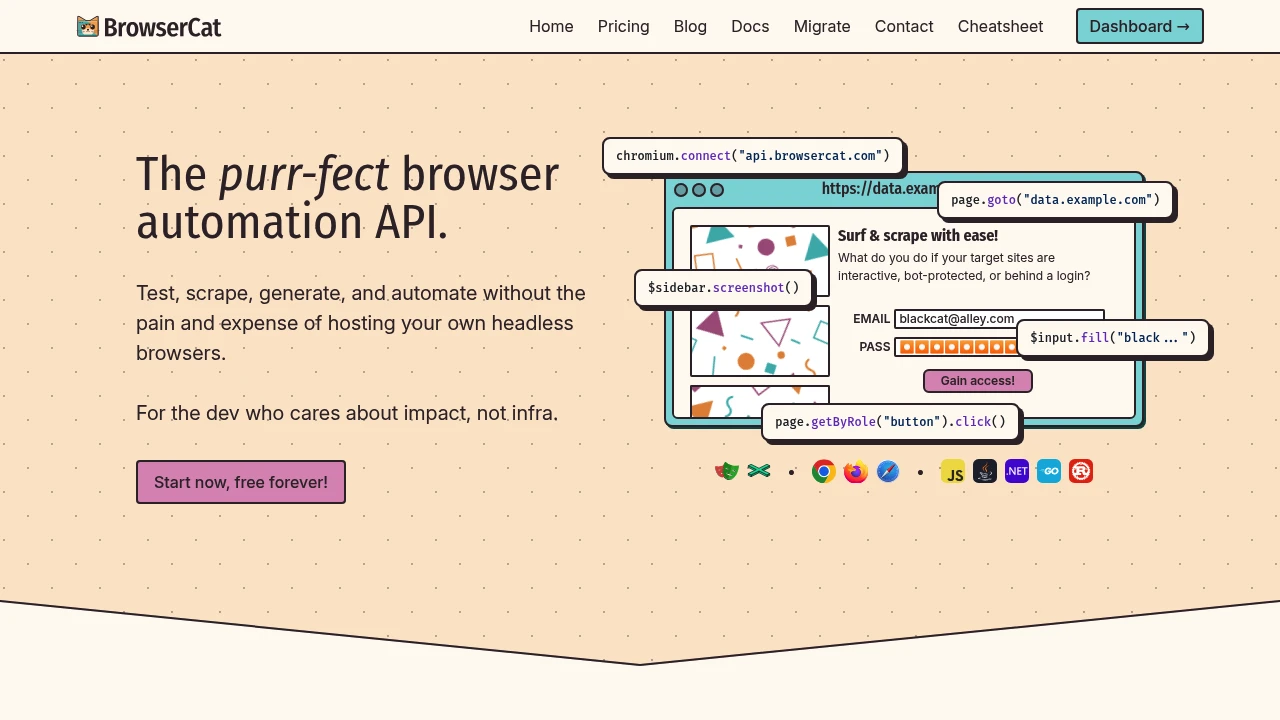
BrowserCat is a headless browser API platform that lets you run browser automation, web scraping, PDF generation, and testing via Playwright, Puppeteer, or Chrome DevTools Protocol—without hosting infrastructure. Built for developers who want to focus on business logic, not server management.
What is BrowserCat?
BrowserCat provides instant-start, globally available headless browser APIs supporting major automation libraries. Connect to cloud browsers with one line of code to execute complex web interactions, data scraping, screenshots, PDF exports, or CI/CD tests—no Docker containers, version conflicts, or scaling headaches. You retain full control: customize launch arguments, feature flags, proxy settings, and region selection, with dashboards for monitoring, usage caps, and log management.
Core Capabilities
- Open-source library support: Compatible with Playwright, Puppeteer, and Chrome DevTools Protocol; zero vendor lock-in
- Instant scale: Launch one or hundreds of browser instances on demand, deployed across global regions
- Full control: Customize launch args, headless modes, proxy requests, and feature flags
- Multi-purpose automation: Web scraping, PDF/image generation, UI testing, monitoring, and AI agent tasks
- Dashboards & alerts: Real-time usage monitoring, cap settings, log access, and notifications
- Bot-detection optimization: Browser configurations mimic real user behavior
Pros
- No need to manage headless browser infrastructure or Docker containers
- Switch from local to cloud execution with one line of code
- Built on mainstream open-source tools; minimal migration cost
- Instant start and elastic scaling for burst or long-running workloads
- Comprehensive docs, quick-start templates, and multi-language support
Cons
- Relies on third-party API; network latency may affect real-time scenarios
- Usage-based pricing may not suit extremely high-frequency continuous tasks
- Residential proxies and CAPTCHA solutions still in beta
- Does not support Selenium or Cypress
- Not suitable for teams requiring fully offline or on-premises environments
Decision Guidance
Use BrowserCat if: You need fast browser automation deployment (scraping, testing, generation) without managing servers; your team is small or wants to focus on product development; you need elastic scaling or multi-region support; you already use Playwright or Puppeteer and want to accelerate CI/CD.
Consider alternatives if: You require fully offline or on-premises deployment; you have continuous high-frequency tasks and are cost-sensitive; you must use Selenium or Cypress; or you already have mature internal headless browser infrastructure with no scaling bottlenecks.
Frequently Asked Questions

Similar to BrowserCat


