Adobe Marketo Engage Alternatives
Discover the best alternatives to Adobe Marketo Engage. Compare features, pricing, and find the perfect replacement.
The best alternative to Adobe Marketo Engage is HubSpot AI. If that doesn't suit you, we've compiled a ranked list of other Adobe Marketo Engage alternatives to help you find a suitable replacement. Other interesting alternatives to Adobe Marketo Engage are: Terminus, Salesforce, Salesloft and Pardot.
Adobe Marketo Engage alternatives are mainly AI Email Outreach, but may also be AI CRM or AI Intent Signals. Browse these if you want a narrower list of alternatives.

Written by Eric Leung
Last updated: May 28, 2026 at 8:00 AM
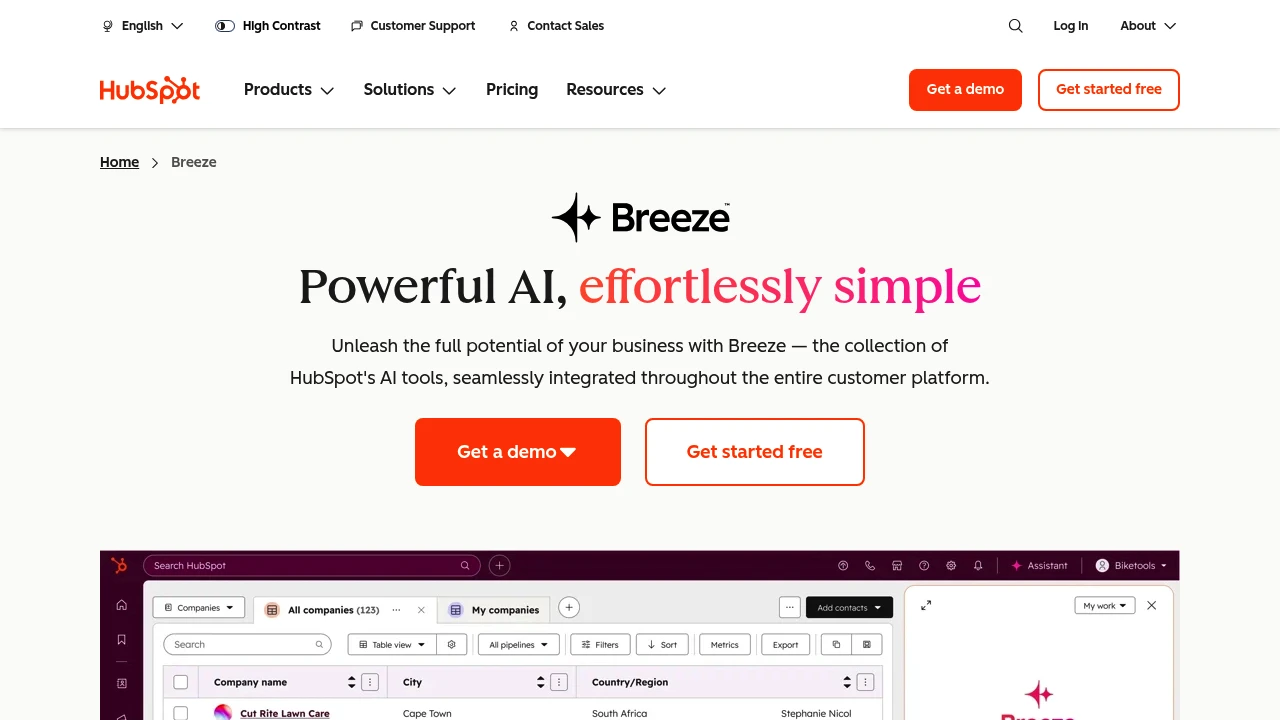
Breeze is HubSpot's AI toolkit integrated across the customer platform. Includes AI assistant, agents, and embedded features to automate content creation, prospecting, and customer service for faster growth.
Summary
Breeze is HubSpot's AI toolkit integrated across the customer platform, helping marketing, sales, and service teams automate workflows, boost productivity, and accelerate growth.
What is Breeze?
Breeze is HubSpot's AI solution comprising three components: Breeze Assistant (AI companion), Breeze Agents (AI-powered teammates), and embedded AI features. Breeze Assistant understands your CRM data and business context, assisting with meeting prep, content creation, and strategic analysis. Breeze Agents are AI-driven virtual team members that automate tasks across content marketing, social media, sales prospecting, and customer service. Embedded features are distributed throughout the HubSpot platform to help you complete daily work quickly.
Core Capabilities
- Breeze Assistant: Personal AI companion with CRM access for meeting prep, content creation, and business analysis
- Breeze Agents: AI teammates that automate workflows across content marketing, prospecting, and customer service
- AI content creation: Rapidly generate blog posts, emails, websites, and social media content
- Prospecting automation: Automatically research prospects, identify buying signals, and craft personalized outreach emails
- Customer service automation: AI trained on your website and knowledge base responds to customer inquiries and converts conversations into self-service articles
- Data insights: Combine CRM data, customer conversations, and web insights to auto-generate answers to business questions
Pros
- Deep integration with HubSpot CRM means AI assistant understands business context and data for relevant recommendations
- Breeze Agents automate repetitive tasks, scaling capacity without expanding headcount
- Embedded AI features throughout platform reduce tool-switching and improve workflow efficiency
- Free tier includes Breeze Assistant and select features, lowering trial barriers
- Trust and safety built in, powered by leading large language models
Cons
- Advanced AI features and Breeze Agents require paid HubSpot subscriptions
- Functionality deeply tied to HubSpot ecosystem; unavailable to non-HubSpot users
- AI agents require installation and customization in Breeze Marketplace, with initial setup time
- Some features still in public beta, with potential stability limitations
- For enterprises with mature AI tool stacks, integration may create overlap
Decision Guidance
Choose Breeze if: You already use HubSpot and want to automate marketing, sales, and service workflows with AI. Breeze offers deep integration and business context understanding, ideal for teams seeking to boost productivity without expanding headcount.
Consider alternatives if: You don't use HubSpot CRM or already have a mature standalone AI toolkit. Teams needing cross-platform AI solutions should evaluate independent AI content or sales tools.

Looking for alternatives to other popular services? Check out other posts in the alternatives series and GTM Guide, a directory of tools with filters for tags and alternatives for easy browsing and discovery.

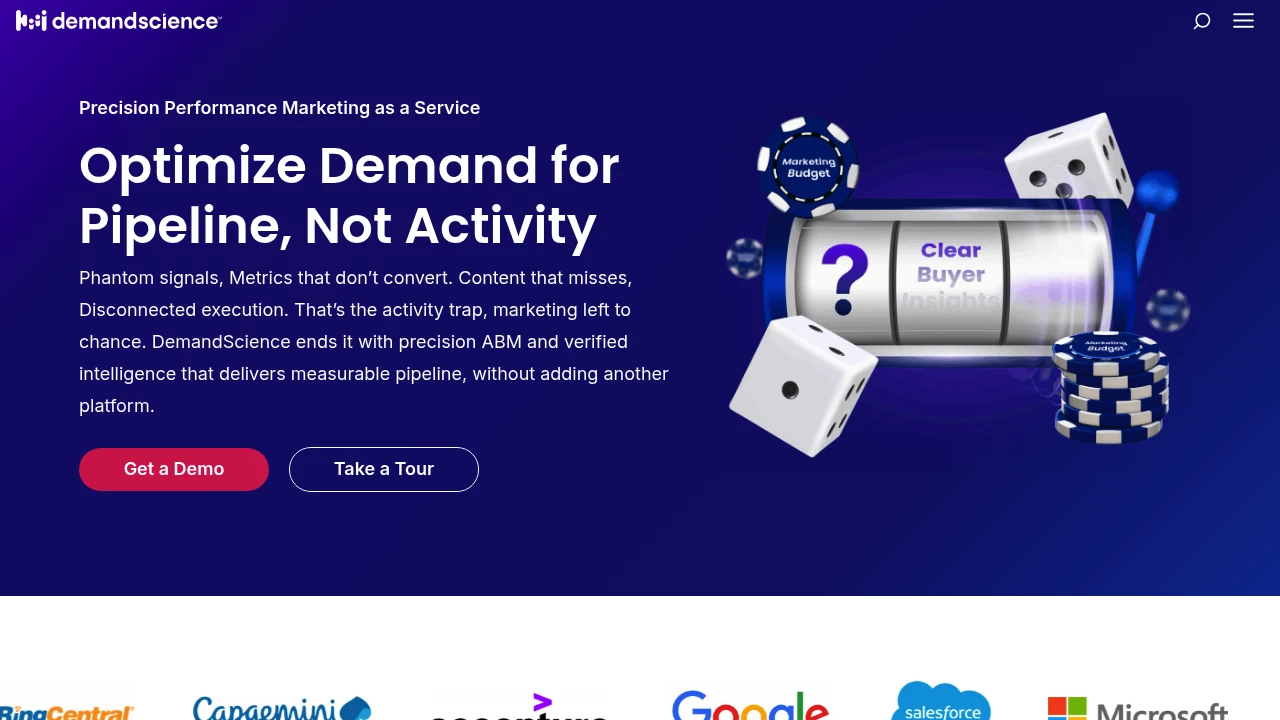
DemandScience combines verified buyer signals, multi-channel orchestration, data management, and expert optimization to help B2B teams convert marketing into measurable pipeline without adding platforms.
Summary
DemandScience is a B2B marketing services platform that combines verified data, multi-channel execution, and expert support to help businesses convert content into actual sales pipeline while avoiding phantom signals and tool sprawl.
What is DemandScience?
DemandScience delivers Precision Performance Marketing as a Service, integrating buyer intelligence, content resonance analysis, automated orchestration, and AI optimization. The platform covers demand generation, advertising, data management, email outreach, event execution, and content production, letting marketing teams focus on pipeline growth without managing additional MarTech tools.
Core Capabilities
- Verified Buyer Signals: Real buyer readiness data with full provenance tracking
- Multi-Channel Orchestration: Automated execution across ads, email, web, and events
- Data Management: Cleanse, enrich, and activate B2B contact data
- Content Studio: Creative design, translation, and content production services
- AI Visibility: Optimize content for discovery by humans and AI search engines
- Continuous Optimization: Expert teams and AI improve performance each cycle
Pros
- Verified buyer signals reduce phantom leads; ad fraud rate just 3% (vs 20% industry average)
- Integrated service model eliminates need for new MarTech platforms, lowering overhead
- Client cases show 417% pipeline boost and 39% shorter sales cycles
- Complete service portfolio from demand generation to event execution
- Expert + AI collaboration provides ongoing optimization support
Cons
- Service model requires reliance on external team, less internal control
- Pricing and service scope not public; requires consultation for evaluation
- Best suited for mid-to-large B2B enterprises; may be costly for small teams
- Integrating with existing MarTech stack may require workflow adjustments
- Results depend on data quality and target market characteristics
Decision Guidance
When to use: B2B enterprises need verified buyer data, multi-channel execution, and expert support while reducing tool management burden to focus on pipeline growth. Ideal for teams with content assets but low conversion or facing phantom signal issues.
Consider alternatives: Teams preferring full control over marketing execution, those with mature MarTech stacks and in-house experts, or budget-constrained small businesses may find point solutions or self-built processes more suitable.

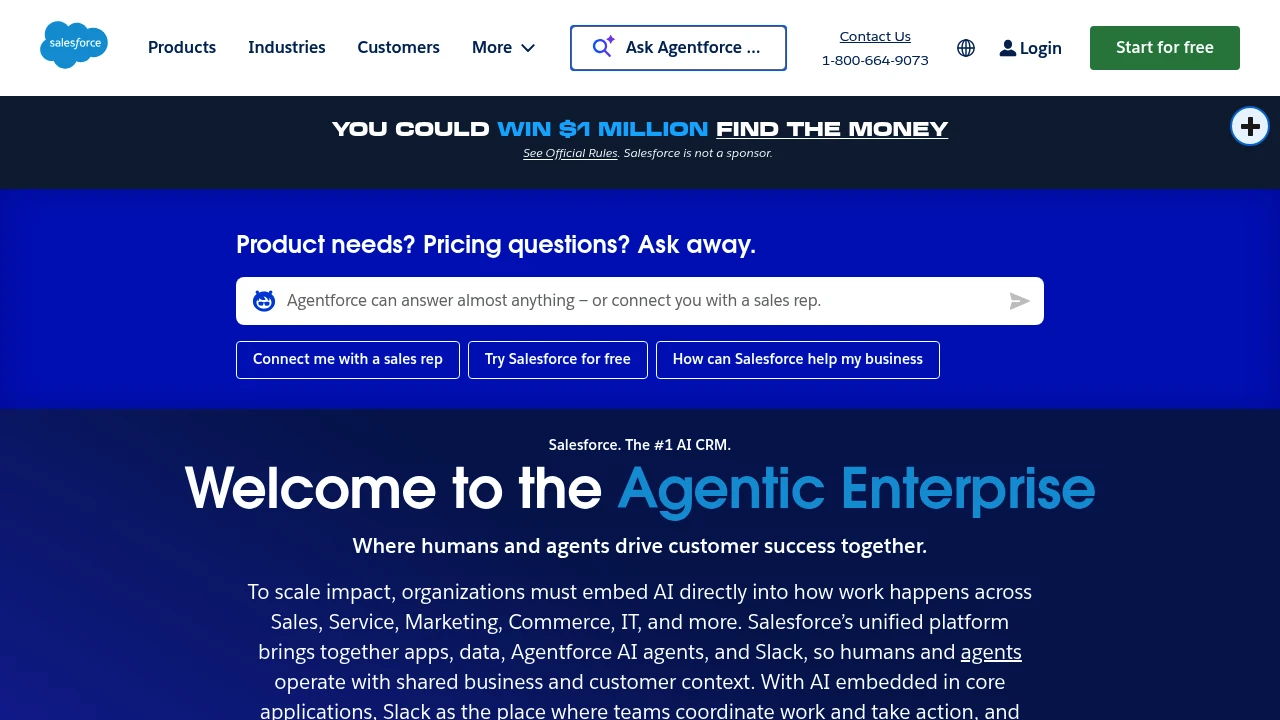
Salesforce is the leading AI CRM platform, integrating sales, service, marketing, commerce, and IT apps. With Agentforce AI agents and unified data, businesses achieve Customer 360 management, higher conversion rates, and automation efficiency.
Salesforce: AI CRM Platform
Summary
Salesforce is the leading AI CRM platform that unifies sales, service, marketing, commerce, and IT apps. Through Agentforce AI agents and integrated data, it enables human-agent collaboration to drive customer success and business growth.
What is Salesforce?
Salesforce is a cloud-based customer relationship management (CRM) platform that brings together applications, data, AI agents, and Slack into a single system. Businesses use Customer 360 to manage customer interactions from lead generation to post-sale service, enabling cross-department collaboration and automated workflows. The platform includes Agentforce AI agents that autonomously execute multi-step tasks, reducing manual work and boosting efficiency.
Core Capabilities
- Agentforce AI agents: Automate customer service cases, lead qualification, and marketing campaigns with 66% autonomous case resolution
- Customer 360 platform: Unify sales, service, marketing, commerce, and IT data for complete customer visibility
- Slack integration: Team collaboration hub with Slackbot as a personal work agent to accelerate decisions and actions
- Industry solutions: 16+ pre-built solutions for finance, healthcare, retail, manufacturing, and more
- Free CRM: Core CRM features with no credit card required, ideal for small businesses to start fast
- AI prediction and personalization: Analyze customer behavior, forecast deal success, and automate personalized interactions
Pros
- Deeply integrated platform: Apps, data, AI agents, and metadata managed in one place, reducing system fragmentation
- Proven AI results: Customer cases show 15% marketing pipeline growth and 1.8x lead conversion rate improvement
- Flexible scalability: From free tier to enterprise plans, expand features as your business grows
- Built-in trust and governance: AI and data security, compliance, and reliability mechanisms enabled by default
- Free learning resources: Agentblazer training offers three-level AI skill certification at no cost
Cons
- Learning curve: Feature-rich platform requires time for new users to master full capabilities and best practices
- Cost accumulation: Advanced features and industry solutions can drive subscription costs up quickly for SMBs
- Customization complexity: Deep customization demands technical resources or external consultant support
- Network dependency: Cloud architecture requires stable internet; offline functionality is limited
- Third-party integration: Some external system integrations need extra configuration or middleware
Decision Guidance
When to use: Businesses needing unified sales, service, and marketing process management; teams wanting AI agents to automate repetitive tasks and elevate customer experience; growing companies seeking scalable CRM solutions.
Consider alternatives: Micro-businesses with tight budgets needing only basic CRM features; organizations requiring fully offline operation; companies deeply invested in other ecosystems (e.g., Microsoft Dynamics) where integration costs are prohibitive.

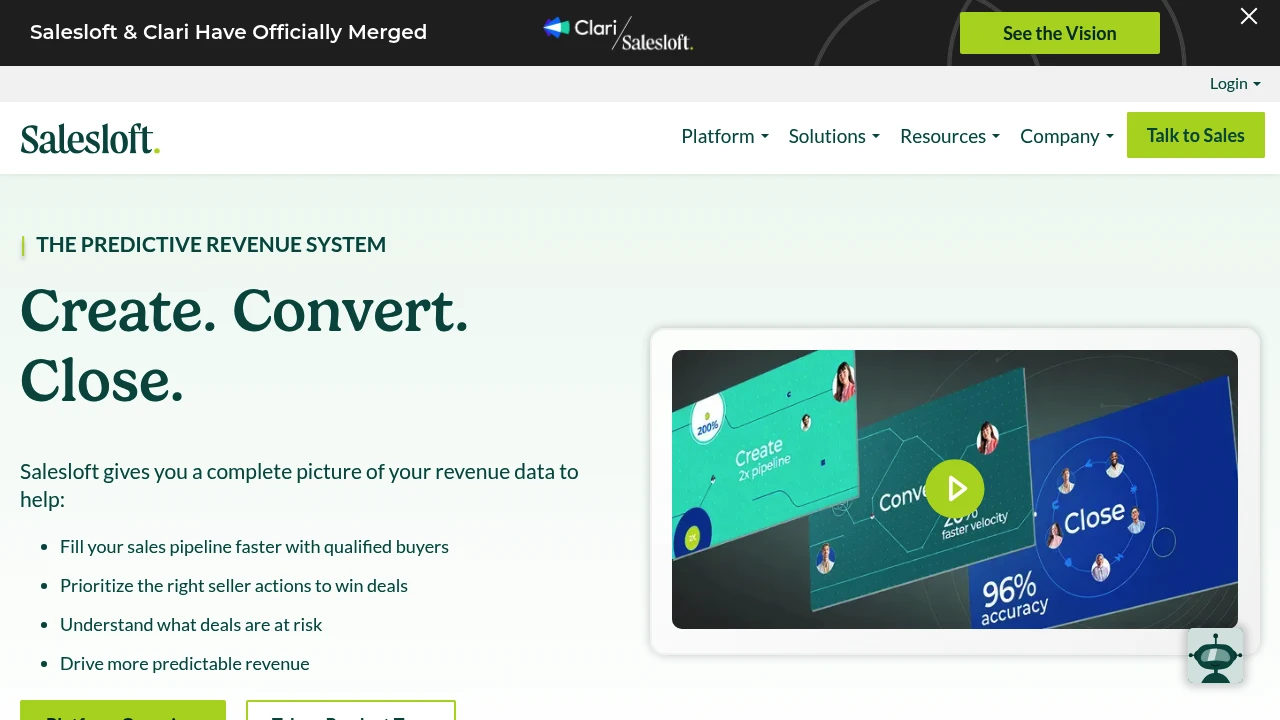
Salesloft unifies AI chat agents, sales engagement, revenue intelligence, conversation analysis, deal management, and forecasting to fill pipeline, accelerate deal cycles, and improve forecast accuracy.
Summary
Salesloft is an AI revenue orchestration platform that unifies sales engagement, revenue intelligence, conversation analysis, deal management, and forecasting tools to help sales teams prioritize high-value actions, accelerate deal cycles, and improve pipeline quality.
What is Salesloft?
Salesloft integrates AI chat agents (Drift), sales engagement (Cadence), revenue intelligence (Analytics), conversation intelligence (Conversations), deal management (Deals), and forecasting (Forecast) into one platform. Through Rhythm, the system turns buyer signals into seller action recommendations, while AI agents automate tedious tasks and surface critical insights. The platform connects with CRM, conferencing, dialer, and email systems to provide revenue teams with a unified data view.
Core Capabilities
- AI chat agents (Drift): Engage website visitors in real-time to convert leads
- Cadence: Automate pipeline generation, lead nurture, and renewal workflows
- Analytics: Centralize reporting across buyer and customer lifecycle data
- Conversations: Analyze sales calls to identify coaching opportunities and best practices
- Deals: AI insights show deal status, risk, and actions needed to accelerate close
- Forecast: Combine real-time deal data and AI to improve forecast accuracy
- Rhythm: Turn buyer signals into prioritized action recommendations
- Integration ecosystem: Connect CRM, conferencing, dialer, email, and calendar tools
Pros
- Unifies multiple revenue tools in one platform, reducing context switching
- AI agents automate prioritization and tedious tasks
- Delivers productivity and pipeline results within 10 days
- Trusted by 5000+ enterprise customers with proven 2.5x faster deal cycles
- Unifies first-party signals, third-party intent data, and sales activity
Cons
- Broad feature set creates a steep learning curve initially
- Pricing not publicly available; requires sales contact
- Primarily designed for enterprise sales teams; may be overkill for small teams
- Requires CRM and tool integrations to unlock full value
Decision Guidance
When to use: Enterprise sales teams needing unified revenue data, automated pipeline generation, improved forecast accuracy, and faster deal cycles will benefit from Salesloft's complete solution. Especially suited for organizations requiring integrated AI chat, sales engagement, conversation analysis, and deal management.
Consider alternatives: Small teams or budget-constrained organizations may find the feature set too complex; if you only need a single capability (like pure conversation intelligence or CRM), specialized tools may be more cost-effective.

Salesforce Marketing Cloud Engagement unifies email, SMS, WhatsApp, push, and digital ads. Use AI-powered Journey Builder to orchestrate personalized customer journeys and boost lifetime value.
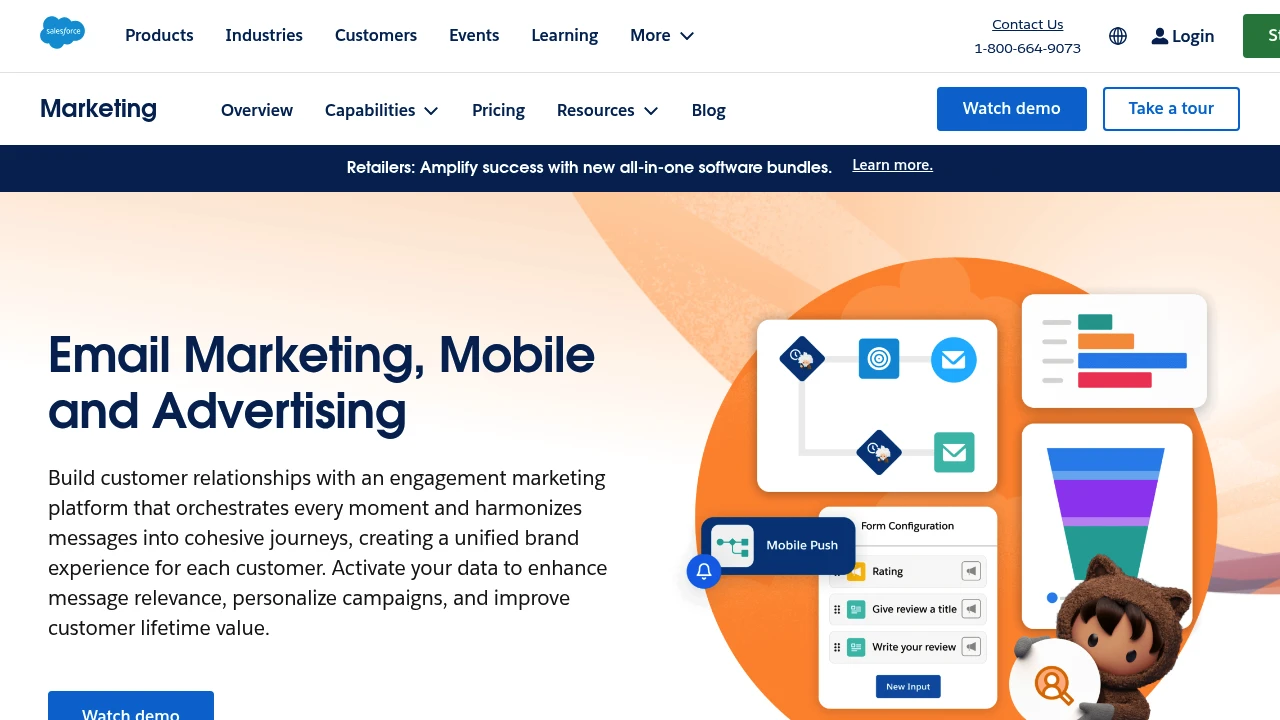
Summary
Salesforce Marketing Cloud Engagement is an enterprise multi-channel marketing automation platform that integrates email, SMS, WhatsApp, push notifications, and digital advertising to help brands orchestrate personalized journeys across the customer lifecycle and increase customer lifetime value.
What is Salesforce Marketing Cloud Engagement?
Salesforce Marketing Cloud Engagement (formerly ExactTarget) is Salesforce's engagement marketing platform that enables marketing teams to design and execute personalized customer journeys across email, mobile messaging, WhatsApp conversations, and digital advertising. The platform features Journey Builder drag-and-drop editor, AI-powered send-time optimization, dynamic content blocks, and cross-CRM integrations, supporting full lifecycle marketing from lead nurturing to loyalty programs.
Core Capabilities
- Email Marketing: Reusable content blocks, A/B testing, dynamic content, and real-time sender reputation management
- Mobile Messaging: SMS, WhatsApp Business Platform, app push notifications, and geolocation triggers
- Journey Builder: Drag-and-drop journey orchestration with API triggers, cross-channel decisioning, and prebuilt templates
- AI Features: Generative AI subject lines and copy, predictive send times, product recommendations, and engagement frequency optimization
- Digital Advertising: First-party data activation to Google, Meta, LinkedIn, and more, with audience suppression
- Cross-CRM Integration: Native connections to Salesforce Sales Cloud, Service Cloud, and Loyalty Management
- Analytics Dashboards: Built-in cross-channel reporting, custom filters, and performance tracking
Pros
- Native Salesforce CRM integration delivers unified customer view across marketing, sales, and service
- Enterprise-grade scalability supports high-volume email sends and high-velocity data ingestion
- Built-in AI tools (Agentforce Campaign Creation) automate subject line generation and send optimization
- Supports WhatsApp and SMS two-way conversations plus in-app messaging
- Rich Trailhead learning resources and community support
Cons
- High pricing starts at $1,500/month (billed annually), creating barrier for SMBs
- Steep learning curve requires time investment to master Journey Builder and AMPscript
- Advanced features (path experimentation, two-way conversations) require upgrade to Advanced edition
- Some users report complex interface requiring technical support for initial setup
- Advertising audience sync depends on third-party platform APIs, occasional delays
Decision Guidance
When to use: Enterprises already on Salesforce CRM that need to orchestrate complex customer journeys across email, mobile messaging, and advertising, with enterprise-grade scalability and AI-driven personalization. Ideal for large marketing teams in retail, financial services, travel, and similar industries.
Consider alternatives: If budget is limited or team size is small, consider HubSpot, Mailchimp, or ActiveCampaign for entry-level platforms. If not using Salesforce CRM ecosystem, Adobe Marketo Engage or Braze may offer more flexible integration options.
Looking for alternatives to other popular services? Check out other posts in the alternatives series and GTM Guide, a directory of tools with filters for tags and alternatives for easy browsing and discovery.

Outreach is an AI revenue workflow platform helping sales, marketing, RevOps, and customer success teams increase win rates through automated workflows, forecasting, and deal management.
Summary
Outreach is an end-to-end AI revenue workflow platform built for sales, marketing, RevOps, and customer success teams. The platform uses AI agents to automate prospecting, deal management, forecasting, and retention, helping teams boost productivity and accelerate deal velocity.
What is Outreach?
Outreach is an integrated sales execution platform that covers the full workflow from prospecting to customer expansion. The platform leverages AI agents to automate research, recommend next actions, identify buying committee members, and deliver real-time conversation insights. Sales leaders can forecast accurately with AI-assisted modeling that reduces prep time and improves revenue predictability.
Core Capabilities
- AI-driven prospecting: Automates research and surfaces best-fit prospects
- Deal management and risk detection: Rapidly inspect pipeline deals, uncover risks, and prioritize actions
- AI-assisted forecasting: Validates calls, compares outcomes, and improves accuracy
- Real-time conversation insights: Spots coaching opportunities and delivers consistent feedback
- Customer retention and expansion: Automates retention plays and flags renewal risks early
- Account orchestration: Identifies and engages all stakeholders to improve win rates
Pros
- Increases seller productivity by 60% with AI-driven workflows
- Consolidates tech stack: Amplitude saved over $600K annually by replacing five platforms
- Accelerates rep onboarding with centralized tools that are easier than standalone CRMs
- Improves forecast accuracy with AI-assisted modeling that reduces prep time
- Delivers real-time coaching feedback to improve team-wide performance
Cons
- Primarily targets enterprise sales teams; may be overkill for small teams
- Requires CRM integration (e.g., Salesforce) to unlock full value
- Steeper learning curve due to comprehensive feature set
- Pricing not publicly available; requires sales contact
- May be overly complex for simple sales processes
Decision Guidance
Use Outreach when: Enterprise sales, marketing, and RevOps teams need end-to-end workflow automation, accurate forecasting, and multi-platform consolidation. Especially suited for teams managing complex buying committees and high deal volumes.
Consider alternatives when: You run a small sales team with simple processes, have budget constraints, need only basic outreach features, or already use specialized tools for specific sales stages.

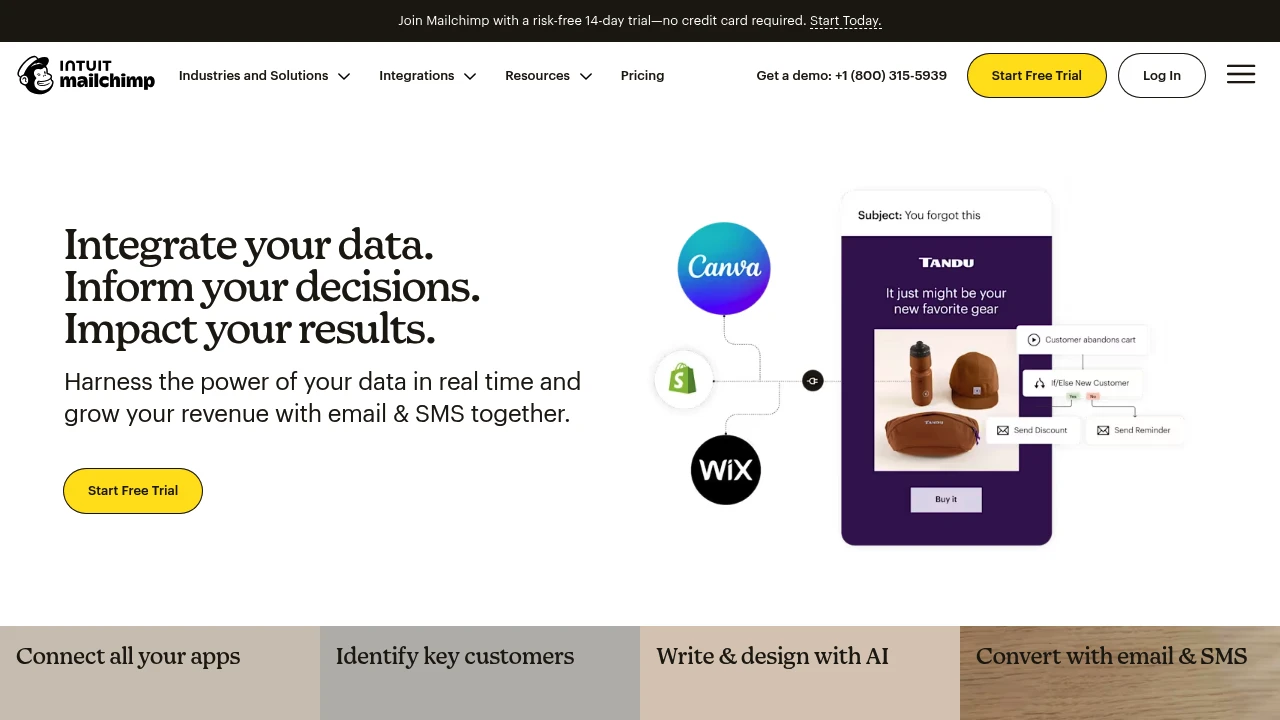
Mailchimp is an AI-powered email and SMS marketing platform offering predictive segmentation, automation, 300+ integrations, and a free plan to boost conversions and ROI.
Summary
Mailchimp is an integrated email and SMS marketing automation platform that uses AI and real-time data to help small and medium businesses boost conversions and revenue. It offers predictive segmentation, generative AI content tools, and 300+ integrations for e-commerce and omnichannel marketing.
What is Mailchimp?
Mailchimp is a data-driven email and SMS marketing platform designed for SMBs and e-commerce. It unifies customer data, behavioral tracking, and third-party apps (Shopify, Salesforce, WooCommerce), then uses AI tools to auto-generate personalized content, identify high-value customers, and optimize send times. Free plan and 14-day Standard trial available, no credit card required.
Core Capabilities
- Email & SMS marketing: Dual-channel reach, up to 97% higher click rates
- AI content generation: Auto-write and design emails; 9.8 billion AI-generated emails sent
- Predictive segmentation: Intelligently identifies customers most likely to engage
- Marketing automation: Trigger personalized workflows based on user behavior
- 300+ integrations: Connect Shopify, Canva, Google Analytics, QuickBooks, and more
- Analytics dashboards: Track audience growth, conversion funnels, and ROI
- Custom forms & popups: Capture leads with customizable signup tools
- Transactional email: 99.99% delivery rate
Pros
- Free plan and 14-day risk-free trial (no credit card)
- AI-driven content and segmentation save time
- Deep e-commerce integrations: Shopify and WooCommerce users see up to 30x ROI
- Intuitive interface for non-technical users
- Personalized onboarding included with Standard and Premium plans
Cons
- Pricing scales quickly with contact count; expensive for large lists
- SMS available in select countries only, requires separate credit purchase
- Advanced automation and custom templates require paid plans
- Free plan limited to 1,000 emails/month and 500 contacts
- Customer support on free plan is email-only, no live chat
Decision Guidance
Use Mailchimp if: You're an SMB or e-commerce business needing integrated email, SMS, and analytics, want AI-powered automation to boost conversions, and already use Shopify, WooCommerce, or similar platforms. Great for startups testing the free plan or 14-day Standard trial.
Consider alternatives if: You need more flexible pricing (e.g., pay-per-send), more powerful advanced automation, or your primary market is in countries where SMS is restricted. Explore ActiveCampaign, Klaviyo, or Brevo instead.

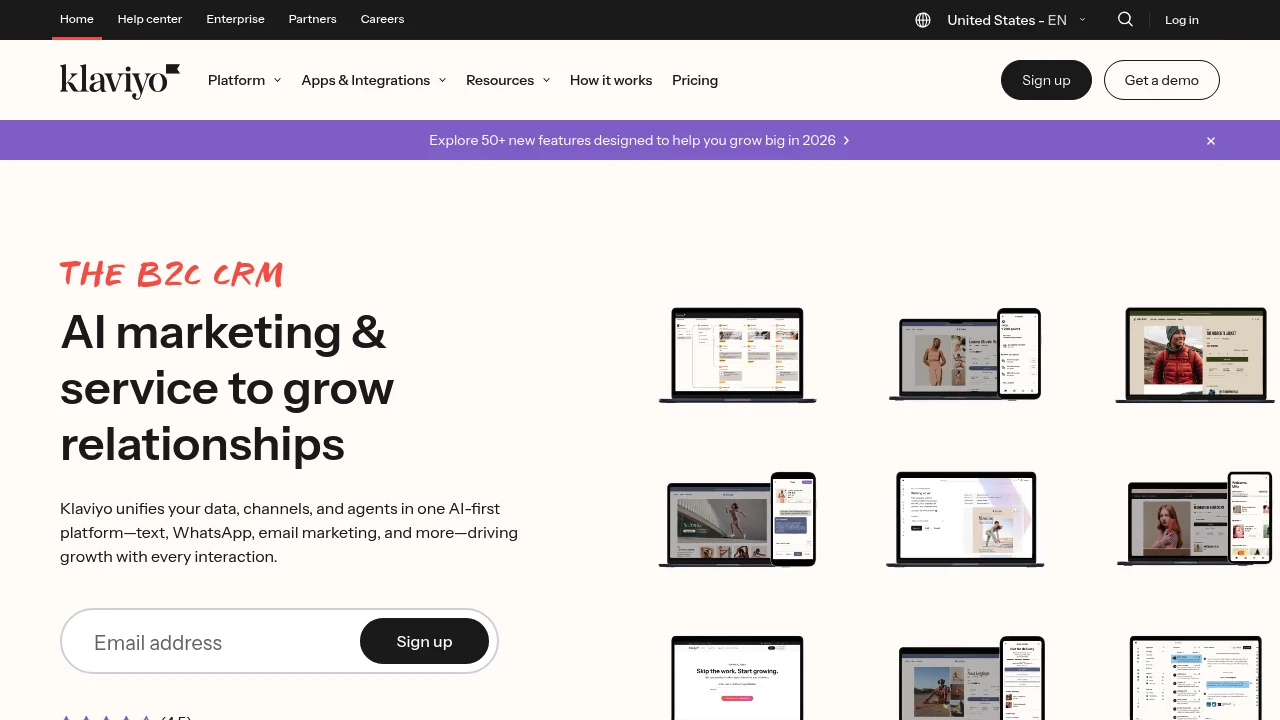
Klaviyo is a B2C CRM platform that unifies AI email marketing, SMS, WhatsApp, and customer service. Automate content, personalize omnichannel experiences, and drive revenue growth.
Klaviyo
Klaviyo is an AI-powered B2C CRM platform that unifies email marketing, SMS, WhatsApp, and customer service, solving data fragmentation and channel silos for consumer brands.
What is Klaviyo?
Klaviyo combines marketing, customer service, and analytics in one platform. K:AI Marketing Agent auto-generates branded content, while K:AI Customer Agent delivers 24/7 support. Built-in CDP unifies customer data, 350+ app integrations connect your stack, and real-time personalization powers ecommerce and B2C growth.
Core Capabilities
- AI Agents: K:AI Marketing Agent creates content; K:AI Customer Agent handles queries and product suggestions
- Omnichannel marketing: Manage email, SMS, WhatsApp, RCS in one place
- Customer Data Platform (CDP): 360-degree customer view, unified data sources
- Klaviyo Helpdesk: Turn service conversations into revenue opportunities
- Analytics & attribution: Multi-touch attribution, real-time campaign tracking
- 350+ integrations: Connect ecommerce platforms, payment tools, and business apps
Pros
- AI agents automate content creation and customer service, reducing manual work
- Unified platform for marketing, service, and data—no tool-switching
- Multi-channel personalization boosts customer engagement
- Built-in CDP delivers complete customer profiles for smarter decisions
- User-friendly for beginners and experts alike
Cons
- Initial setup requires time to integrate data sources and configure workflows
- Advanced features have a learning curve, especially automation and segmentation
- Pricing scales with contact count, potentially costly for growing SMBs
- Customer support response times vary according to some users
- Primarily built for ecommerce and B2C; limited B2B functionality
Decision Guidance
Use Klaviyo when: You're an ecommerce brand needing a unified marketing and service platform, want AI to automate content and customer interactions, and need to integrate multi-channel data to boost retention and revenue.
Consider alternatives if: Your business is primarily B2B, you need more flexible pricing, or you already have a mature CRM and only need a single-channel marketing tool.

HubSpot integrates CRM, marketing, sales, and customer service on one AI-powered platform with Breeze agents that automate workflows, helping 278,000 businesses grow faster.
Summary
HubSpot is an AI-powered customer platform that unifies marketing, sales, customer service, and CRM to help businesses consolidate data, automate processes, and accelerate growth.
What is HubSpot?
HubSpot is a comprehensive customer platform that combines Marketing Hub, Sales Hub, Service Hub, Content Hub, Data Hub, Commerce Hub, and Smart CRM in a single system. The platform includes built-in Breeze AI tools and agents (Customer Agent, Prospecting Agent, Data Agent) that automate customer inquiries, sales outreach, and content creation. Over 278,000 businesses across 135 countries use HubSpot to manage customer relationships and drive business growth.
Core Capabilities
- Smart CRM: Unified customer data as the single source of truth for all business information
- Marketing Hub: Marketing automation, lead conversion, personalized content, and campaign tracking
- Sales Hub: Lead generation, pipeline management, automated outreach, and deal acceleration
- Service Hub: AI-powered customer support, ticketing, customer health scores, and usage analytics
- Content Hub: Content creation, multi-channel publishing, and brand consistency management
- Breeze AI Agents: 24/7 automation for customer inquiries (resolves 65%), sales research, and content generation
- Data Hub: Data integration, cleansing, and cross-team activation
- Commerce Hub: Quoting, payment collection, and subscription management
- 2,000+ Integrations: Connect existing tools and applications
Pros
- Unified platform: All marketing, sales, and service tools in one AI-powered system eliminate data silos
- Proven results: Customers gain 129% more leads, 36% more deals, and 37% better ticket closure rates within one year
- Built-in AI: Breeze agents automate 65% of customer inquiries, accelerate sales outreach, and generate content
- Flexible scaling: From Small Business Bundle to Enterprise plans, adapts to different team sizes
- Rich ecosystem: 2,000+ integrations, free tools, and active community support
Cons
- Learning curve: Multi-product platform requires time to master all features and best practices
- Cost accumulation: Advanced features and multiple Hub subscriptions can strain budgets for small businesses
- Customization limits: Some enterprise-level needs may require additional development or third-party integrations
- Data migration: Moving from other CRM systems requires planning and resource investment
- Feature overlap: Some functionality overlaps across different Hubs, requiring careful plan selection
Decision Guidance
Use HubSpot when: You need to unite marketing, sales, and customer service teams and want AI automation to boost efficiency and accelerate growth. Particularly suited for small to enterprise organizations seeking an integrated platform to replace scattered tools, valuing data unification and scalability.
Consider alternatives when: You only need single functionality (like pure CRM or email marketing) rather than a full platform, or have limited budget without need for advanced AI features. Businesses deeply invested in other ecosystems (like Salesforce) may face migration costs.

GetResponse offers email marketing, automation, landing pages, and SMS with AI that writes content, recommends send times, and helps convert leads into revenue.
GetResponse: Email Marketing & Automation Platform
GetResponse is an integrated platform for email marketing, automation, landing pages, and SMS, helping businesses boost conversion with AI-powered tools. Built for ecommerce, entrepreneurs, and brands expanding their customer base.
What is GetResponse?
GetResponse is an all-in-one marketing platform offering unlimited email sends, automation workflows, and landing page creation. Built-in AI assists with subject lines, send-time optimization, and content recommendations, supporting over 150 integrations. The platform claims a 99% deliverability rate across 160+ countries and serves 350,000+ customers.
Core Capabilities
- AI email writing: Auto-generates subject lines, tailors content, and recommends optimal send times
- Unlimited automation: Build welcome sequences, cart recovery, and re-engagement journeys
- Landing page builder: AI writes copy, selects layouts, and speeds up launch
- SMS marketing: Reach customers directly via SMS, integrated in one platform
- AI product recommendations: Personalize website and email product suggestions
- Webinar hosting: Record, promote, and nurture leads through webinars
- Forms and popups: Create banners and popups to engage visitors
- 150+ integrations: Connect CRM, ecommerce, and other tools
Pros
- Unlimited emails, automations, and landing pages at affordable pricing as you scale
- AI features cover content writing, send-time optimization, and product recommendations
- 99% email deliverability across 160+ countries
- 24/7 customer support with five-star ratings
- 14-day free trial, no credit card required
Cons
- Advanced features (webinars, sales funnels) require higher-tier plans
- AI writing quality depends on input data and may need manual tweaks
- Feature-rich interface can overwhelm new users
- Some integrations need extra setup or third-party tools
Decision Guidance
Use GetResponse if: You need integrated email, automation, landing pages, and SMS for a small to mid-sized business or ecommerce store; you want AI to speed up content creation and optimize send times; you're looking for unlimited sends with pricing that stays reasonable as you grow.
Consider alternatives if: You only need basic email for a small team and prefer simpler tools; you require deep CRM integration or complex sales processes better served by specialized platforms; you have a very tight budget and want to start with free or lower-cost entry-level tools.
Looking for alternatives to other popular services? Check out other posts in the alternatives series and GTM Guide, a directory of tools with filters for tags and alternatives for easy browsing and discovery.

Demandbase is a B2B ABM platform that integrates first- and third-party data, uses AI to identify buying groups, and automates marketing and sales workflows to boost pipeline velocity.
Demandbase Review
Demandbase is an account-based marketing (ABM) platform for B2B enterprises, unifying data, AI insights, and automated execution to help sales and marketing teams identify buying groups and accelerate pipeline conversion.
What is Demandbase?
Demandbase merges first-party CRM and web activity with third-party intent data into a unified account view. Its AI agents (Agentbase) automate signal detection and orchestrate cross-channel actions. The platform offers account identification, web personalization, B2B ad targeting, sales tools, and analytics—focusing on buying groups rather than individual contacts, ideal for enterprise sales requiring multiple decision-makers.
Core Capabilities
- Buying group identification: Integrates account, contact, and buying group data to reveal full decision teams
- Intent data & signal integration: Combines first-party behavior and third-party intent signals for real-time purchase detection
- AI-driven automation: Pipeline AI triggers marketing and sales workflows automatically
- Native B2B ad platform (DSP): Intent-based, hyper-targeted ad delivery
- Web personalization & orchestration: Dynamically adjusts content and messaging by account stage
- Tech stack integrations: APIs and native connectors for CRM, marketing automation, and sales engagement platforms
Pros
- Unified data view: Consolidates multi-source data into a single account truth, reducing silos
- Transparent AI logic: Shows reasoning behind recommendations, not a black box
- Buying group focus: Targets decision teams, not individuals, improving enterprise close rates
- Native ad DSP: No external ad platform needed; intent data drives targeting directly
- Flexible integration: Open APIs and bi-directional data flow fit existing tech stacks
Cons
- Steep learning curve: Feature-rich platform takes time to master; may overwhelm smaller teams
- Pricing not public: Requires sales contact for quotes, lacks transparency
- Depends on data quality: Incomplete first-party data reduces AI accuracy
- Enterprise-focused: May exceed budget or needs for SMBs
- Integration needs tech resources: Complex setups may require dev team support
Decision Guidance
When to use: Enterprise B2B companies needing unified sales and marketing data, targeting multi-stakeholder decision processes, and deep integration with mature CRM and marketing automation systems. Customer cases show 3× conversion lift and 83% faster pipeline velocity.
Consider alternatives: Smaller teams with limited budgets, simple sales cycles, or basic lead management needs may prefer HubSpot, 6sense, or ZoomInfo. If you lack dedicated marketing ops staff, build data foundations first before adopting.
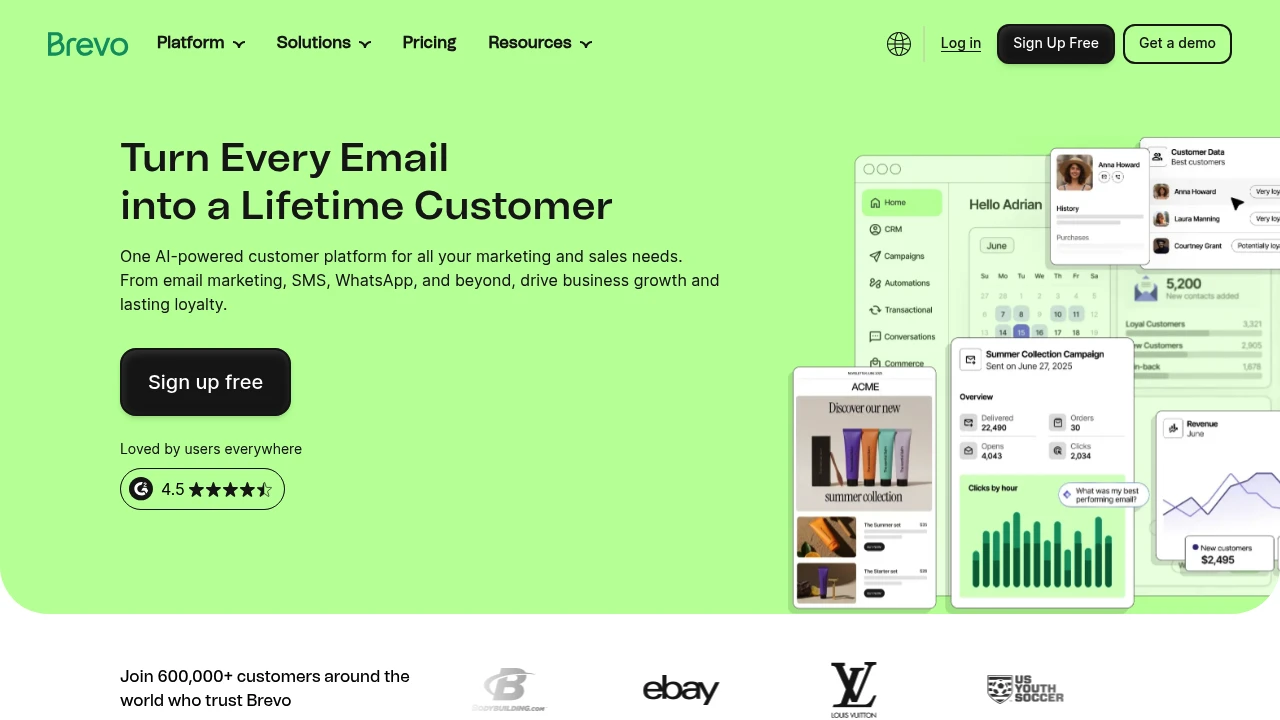
Brevo offers email marketing, SMS, WhatsApp, CRM, live chat, and transactional email with AI-powered automation. Trusted by 600K+ users. Free trial available.
Brevo: Email & SMS Marketing, CRM & Automation Platform
Brevo is a multichannel customer engagement platform combining email, SMS, WhatsApp, CRM, live chat, and transactional email. AI-driven automation tools boost conversions and loyalty. Trusted by over 600,000 users worldwide, from startups to enterprise.
What is Brevo?
Brevo is an all-in-one customer engagement platform that manages marketing, sales, and customer relationships in a single interface. It offers a drag-and-drop editor, ready-made templates, and no-code automation tools for non-technical users to launch campaigns quickly. Built-in Aura AI agents auto-generate copy, optimize send times, recommend products, and analyze data to eliminate busywork. Integrates with over 150 third-party tools including ecommerce, CMS, and CRM systems.
Core Capabilities
- Multichannel marketing: Email, SMS, WhatsApp, live chat, and push notifications
- AI agents (Aura): Auto-generate copy, segment audiences, optimize send times, and recommend products
- CRM & sales tools: Contact management, deal tracking, automated sales emails
- Marketing automation: No-code workflows, advanced segmentation, web tracking
- Transactional email: Order confirmations, password resets, and system emails
- Live chat & conversation summaries: AI-powered chat summaries and tone adjustments
- Data analytics: Natural language queries and visual reports
Pros
- Drag-and-drop editor and templates make it easy for non-technical users
- AI agents automate copywriting, segmentation, and send-time optimization
- Combines email, SMS, WhatsApp, CRM, and live chat in one platform
- Integrates with 150+ third-party tools
- Free plan available with no credit card required
Cons
- Advanced features (AI agents, WhatsApp) require paid plans
- Some users report a steeper learning curve than expected
- Free plan has daily sending limits
- Certain integrations require additional setup
Decision Guidance
Choose Brevo if you need multichannel marketing tools for SMBs or ecommerce, want to manage email, SMS, CRM, and automation in one platform, and use AI to reduce manual work. Ideal for budget-conscious teams that need scalability.
Consider alternatives if you only need a single channel (e.g., email-only) or already have a dedicated CRM system—specialized tools may fit better. Large enterprises requiring deep customization or on-premise deployment may need enterprise-grade solutions.

ActiveCampaign's autonomous marketing platform uses AI agents to build and optimize email, SMS, WhatsApp journeys. Integrates 1,000+ apps to cut time to market.
Summary
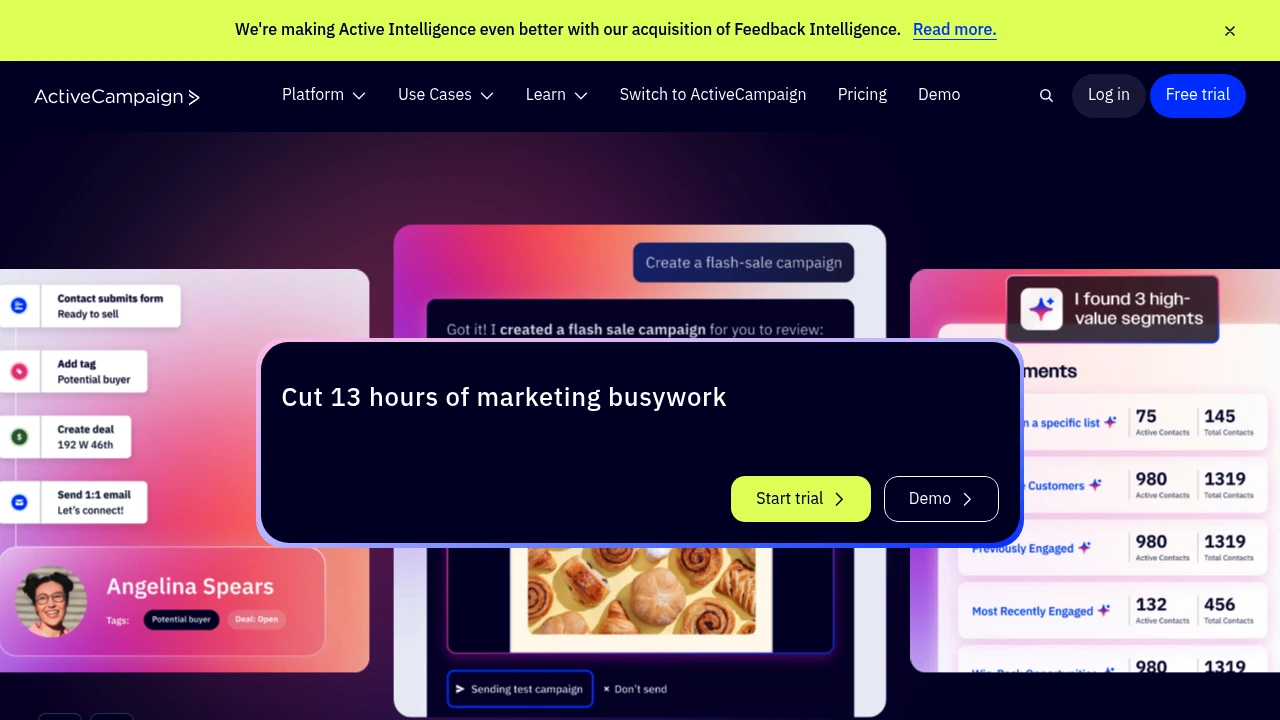
ActiveCampaign is an autonomous marketing platform that uses AI agents to automate email, SMS, and WhatsApp strategy execution, solving the burden of manually building workflows and analyzing data. The platform claims to save 13 hours of marketing work per week.
What is ActiveCampaign?
ActiveCampaign goes beyond traditional marketing automation through Active Intelligence technology that lets AI agents automatically build and optimize customer journeys, email content, and multi-channel strategies based on your goals. The platform unifies email, SMS, WhatsApp, transactional email, and landing pages, connecting over 1,000 apps with Claude and ChatGPT integration.
Core Capabilities
- AI orchestration: AI agents auto-create personalized email, SMS, and WhatsApp strategies
- Multi-channel automation: Manage email, SMS, WhatsApp, transactional email, and web experiences in one place
- Customer journey optimization: Automate and optimize customer interaction flows
- Visual reporting: Summarize campaign progress and goal achievement
- Integration ecosystem: Connect 1,000+ apps including Claude and ChatGPT
- Email and form builder: Create emails, forms, and landing pages
- Deliverability management: Ensure email inbox placement
Pros
- AI agents build strategy automatically without manual workflow setup
- Unifies email, SMS, WhatsApp in a single platform
- 1,000+ app integrations including AI tools
- 30-day money-back guarantee and 14-day free trial
- Supports agencies, e-commerce, education, healthcare, and other industries
Cons
- Autonomous marketing features may require time to learn and adjust goal settings
- Pricing for advanced AI features not clearly listed on website
- Small teams may not need all channels and integration capabilities
- Time-saving claim (13 hours/week) lacks verification source
Decision Guidance
Use when: You need cross-channel automation across email, SMS, WhatsApp, want AI agents to build strategy instead of just executing preset flows, or require extensive third-party tool integration.
Consider alternatives: Small teams needing only basic email automation, limited budgets without multi-channel needs, or users preferring full manual control over every marketing workflow.

6sense is a B2B predictive intelligence platform that uses AI to identify buyer intent, optimize marketing and sales strategies, and boost conversion rates.
6sense
6sense is a B2B predictive intelligence platform that helps companies identify prospects actively researching their products, optimize marketing and sales workflows, and drive revenue growth.
What is 6sense?
6sense uses AI and big data analytics to track anonymous buyer behavior, predict purchase intent, and enable marketing and sales teams to engage high-value prospects at the right moment. The platform integrates multi-channel data to deliver account-level insights, helping B2B organizations shorten sales cycles and improve close rates.
Core Capabilities
- Buyer intent data: Track anonymous research behavior and identify demand signals
- Predictive analytics: AI scores account likelihood and timing to purchase
- Account prioritization: Automatically flag high-value target accounts
- Multi-channel orchestration: Personalize interactions across ads, email, and web
- Sales intelligence: Real-time alerts on key account activity
Pros
- Discover potential buyers early and gain competitive advantage
- AI-driven account prioritization boosts team efficiency
- Unified view of marketing and sales data
- Shortens sales cycles and increases conversion rates
- Supports enterprise-scale ABM strategies
Cons
- High cost creates budget pressure for SMBs
- Requires sufficient data volume to deliver value
- Steep learning curve and need for dedicated management
- Some features depend on third-party data sources
- Initial setup and integration can be time-intensive
Decision Guidance
Best for: B2B enterprises running account-based marketing (ABM) that need to predict buyer intent, optimize high-value customer acquisition, and have adequate budget and data infrastructure.
Consider alternatives: Smaller businesses with limited budgets, shorter sales cycles, or smaller customer bases may find better value in lower-cost CRM or marketing automation tools.


