Bombora Alternatives
Discover the best alternatives to Bombora. Compare features, pricing, and find the perfect replacement.
The best alternative to Bombora is Keyplay. If that doesn't suit you, we've compiled a ranked list of other Bombora alternatives to help you find a suitable replacement. Other interesting alternatives to Bombora are: Enlyft, Factors, Dealfront and Koala.
Bombora alternatives are mainly AI Intent Signals, but may also be Visitor Identification or AI Visitor Identification. Browse these if you want a narrower list of alternatives.

Written by Eric Leung
Last updated: June 23, 2026 at 8:00 AM
Keyplay helps you identify ideal customer accounts (ICA) with buying signals and data enrichment, enabling B2B teams to target precisely and boost conversion.
Summary
Keyplay is a B2B account research and sales intelligence platform that helps sales and marketing teams identify, prioritize, and engage high-potential customer accounts. It combines buying signals, data enrichment, and CRM sync to solve the problem of inconsistent lead quality and imprecise targeting.
What is Keyplay?
Keyplay is an account intelligence tool designed for B2B SDRs, account executives, and marketing teams. It uses real-time buying signals (like tech stack changes, hiring activity, funding news) and customizable ideal customer profile (ICP) filters to help teams quickly find the most likely-to-close accounts and automatically sync them to CRM or outreach tools.
Core Capabilities
- Ideal Customer Account (ICA) identification: Build dynamic account lists based on industry, company size, tech stack, geography, and more
- Buying signal tracking: Monitor funding, hiring, technology adoption, leadership changes, and other real-time signals
- Data enrichment and validation: Automatically capture and update contact details, company information, and missing fields
- CRM and tool integrations: Two-way sync with Salesforce, HubSpot, Outreach, and other platforms
- Collaboration and sharing: Team members can share account lists, signals, and research notes
Pros
- Precise ICP filters reduce manual research time
- Real-time buying signals improve outreach timing and relevance
- Seamless integration with major CRM and sales tools
- Intuitive interface for team collaboration and list sharing
- Data enrichment automatically fills CRM gaps
Cons
- Pricing not publicly available; requires contacting sales
- May be costly for small teams or startups
- Data coverage primarily focused on North American markets
- Learning curve exists; takes time to configure ICP and signal rules
- Some advanced features require additional setup or technical support
Decision Guidance
Use Keyplay if: Your team focuses on B2B account-based sales (ABM), needs real-time buying signals and precise ICP filtering, and already uses CRM and outreach tools. Keyplay can significantly improve lead quality and conversion rates.
Consider alternatives if: You have a limited budget, primarily serve SMBs, or need broader international data coverage. Alternatives like Apollo.io, ZoomInfo, or Cognism may be worth exploring.

Looking for alternatives to other popular services? Check out other posts in the alternatives series and GTM Guide, a directory of tools with filters for tags and alternatives for easy browsing and discovery.

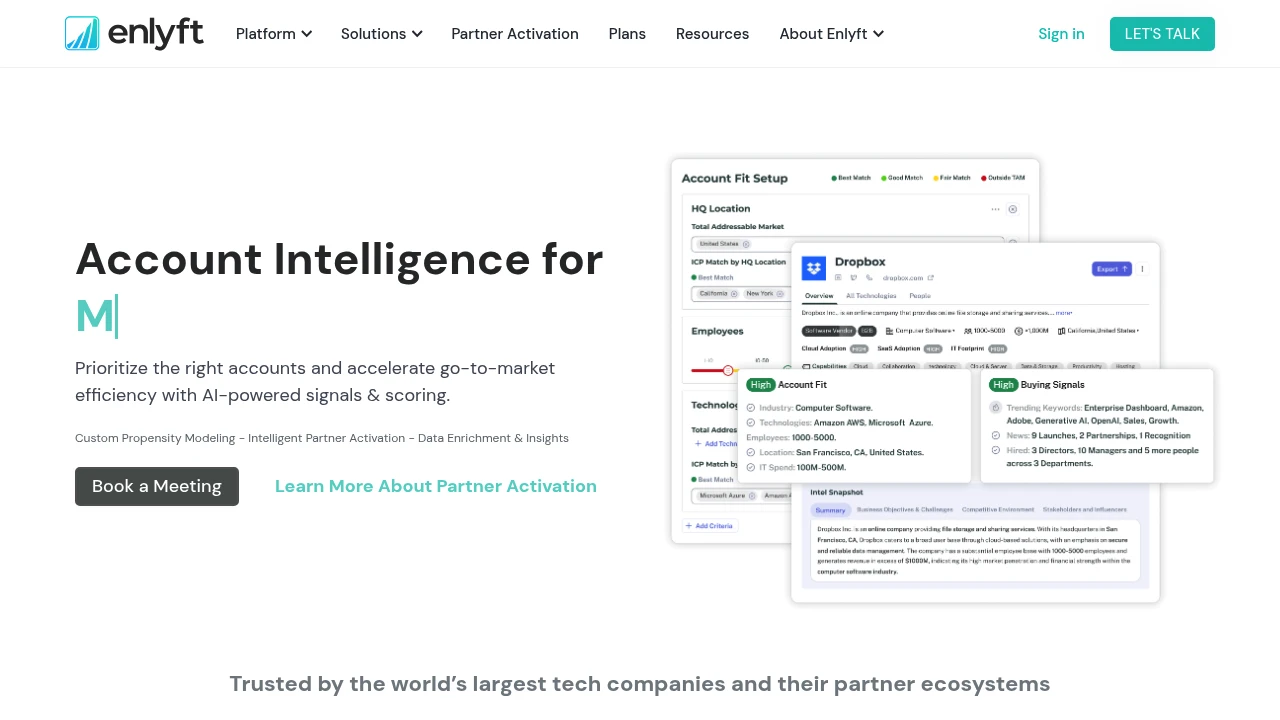
Enlyft is a B2B customer acquisition and account intelligence platform that uses AI propensity models, technographic data, buying signals, and data enrichment to help sales, marketing, and partner teams prioritize top opportunities.
Summary
Enlyft is a B2B customer acquisition and account intelligence platform that uses AI-powered propensity modeling and real-time scoring to help sales, marketing, and partner teams target high-potential accounts and accelerate go-to-market efficiency.
What is Enlyft?
Enlyft provides custom AI propensity modeling, technographic data, buying intent signals, and data enrichment across 36M+ companies, 20,000 technologies, and 300M people profiles. The platform integrates with Salesforce, Dynamics 365, HubSpot, LinkedIn, and other tools to embed account intelligence into existing workflows, and offers intelligent partner activation for ecosystems with account mapping and prioritization.
Core Capabilities
- Custom AI propensity models: Real-time account scoring based on firmographics, technographics, and partner activity
- Technographic and buying signal data: Coverage of 20,000 technologies and hundreds of attributes
- Data enrichment and insights: Automatic updates to CRM and marketing platform records
- Intelligent partner activation: Unified vendor, partner, and market signals for cross-sell and new customer acquisition
- Native integrations: Support for Salesforce, Dynamics 365, HubSpot, LinkedIn, and more
Pros
- Custom AI models tuned to specific ICP and GTM motion improve account prioritization accuracy
- Proprietary database of 36M+ companies and 20,000 technologies suits large addressable markets and multi-solution sales
- Native integrations with major CRM and marketing tools require no workflow changes
- Purpose-built account mapping and intelligence sharing for partner ecosystems
- Customer case studies show doubled sales win rates, 30% lift in opportunity value, and 5X–9X MQL growth
Cons
- Pricing and plan details not publicly available; requires sales contact
- Primarily targets large enterprises and partner ecosystems; may be overkill for smaller teams
- Requires technical integration and data management capability to extract full value
- Steeper learning curve, especially for custom propensity model setup and tuning
Decision Guidance
Choose Enlyft if: Your team sells multiple solutions or targets large markets and needs custom AI propensity models and technographic data to prioritize accounts; you operate a partner ecosystem and need to unify vendor and partner signals; you already use Salesforce, HubSpot, or Dynamics 365 and want automated account enrichment.
Consider alternatives if: You're a small team needing basic contact data and enrichment without complex propensity modeling; your budget is limited and you need transparent pricing and self-service options; you don't rely on partner channels and primarily do direct sales.

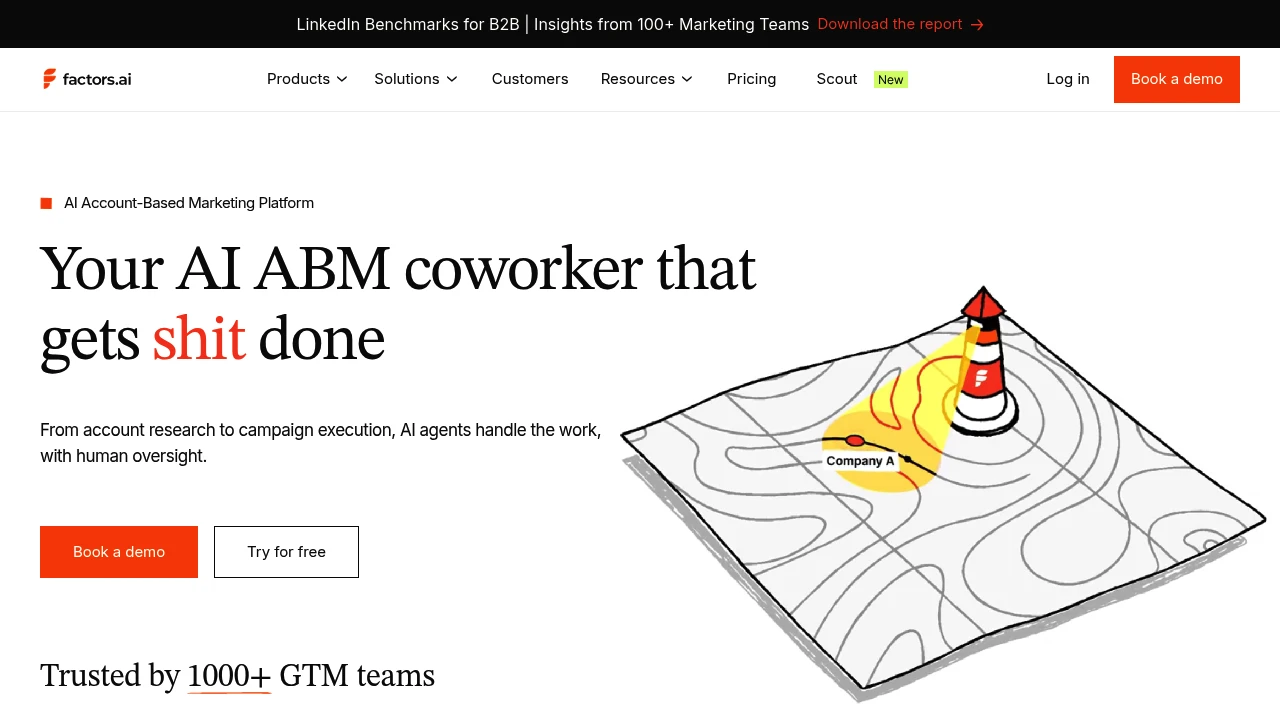
Factors.ai unifies intent data from website, ads, CRM, and G2. AI agents automate account identification, ABM campaigns, and sales outreach to help B2B teams discover high-quality opportunities and track revenue attribution.
Summary
Factors.ai is an AI-powered B2B demand generation platform that unifies intent signals, account identification, ABM ad campaigns, and revenue attribution to help marketing and sales teams uncover high-quality opportunities from hidden buyer journeys and accelerate deal closure.
What is Factors.ai?
Factors.ai consolidates intent data scattered across website, ad platforms, CRM, G2, and third-party sources into a single platform, using AI agents to automate every step of demand generation. The platform identifies anonymous visitors via reverse IP lookup (over 75% coverage), builds dynamic account lists based on behavior and firmographics, and powers precise LinkedIn and Google ad targeting plus intent-driven sales outreach. Teams can track each touchpoint's contribution to revenue and receive AI-powered next-step recommendations.
Core Capabilities
- Account identification & intent capture: Reverse IP lookup to identify website visitors; multi-channel intent signals (website, ads, CRM, G2, third-party data)
- AI-driven account prioritization: Dynamic account lists, behavioral and firmographic filters, buying-readiness scoring
- ABM ad campaigns: Account-level control for LinkedIn and Google ads, audience segmentation by buyer stage, enriched conversion data pass-back
- Sales intelligence & outreach: Intent-based account prioritization, AI-generated account context and next steps, real-time alerts via Slack and CRM
- Revenue attribution & analytics: Full-funnel touchpoint tracking, channel and segment performance reports, integrations with CRM, ad platforms, and G2
Pros
- Account identification coverage exceeds 75%, above the industry average of 40%
- AI agents automate demand gen workflows from signal to action
- Unifies multi-channel intent data, eliminating tool silos
- White-glove onboarding and ongoing business review support
- SOC 2 Type II, ISO 27001, and GDPR certified
Cons
- Primarily targets B2B SaaS and enterprise software teams; may not suit B2C or small local businesses
- Requires integration with CRM, ad platforms, and website tracking to unlock full value
- Pricing not publicly disclosed; requires sales contact
- Learning curve may be steep, especially for teams new to ABM platforms
- Some AI features (e.g., conversational analytics) still in development
Decision Guidance
Use Factors.ai if: You're a B2B SaaS or enterprise software company that needs to unify intent signals, run ABM ad campaigns, equip sales with account intelligence, and automate demand gen workflows with AI. Especially suited for growth teams already using multiple tools but lacking a unified view.
Consider alternatives if: You're a B2C business, small local company, or only need basic website analytics and ad tracking—simpler tools may be more appropriate. If budget is tight or team size is under 10, evaluate cost-effectiveness first.

Dealfront helps you identify, prioritize, and engage high-intent accounts to boost conversions and hit revenue goals. Combines 60M company database, real-time buying signals, and website visitor tracking for sales and marketing teams.
Summary
Dealfront is an account-based marketing (ABM) sales and marketing platform that helps teams identify high-fit accounts, prioritize prospects showing buying intent, and accelerate deal closure. Solves low pipeline quality and conversion inefficiency.
What is Dealfront?
Dealfront integrates a global company database (60M companies, 400M verified contacts), real-time buying signal tracking, and website visitor identification to help sales and marketing teams focus on accounts ready to buy. The platform offers 100+ filters, 40+ real-time buying signals, and supports CRM integrations, Slack and email alerts to ensure teams engage prospects at the right moment.
Core Capabilities
- Company & contact database: Access 60M companies and 400M verified contacts with 100+ advanced filters
- Buying signal tracking: Monitor 40+ real-time signals to identify accounts showing purchase intent
- Website visitor identification: Reveal ICP-fit companies visiting your site, pages viewed, and time spent
- Real-time alerts: Automatically notify sales teams of high-intent account activity via Slack or email
- CRM integrations: Auto-push qualified accounts to CRM systems to speed up follow-up
- Dealfront Promote: Reach high-value accounts via display ads and LinkedIn (>90% audience match)
Pros
- Combines database, buying signals, and website tracking in one platform, reducing tech stack complexity
- Real-time alerts let sales teams engage prospects at the optimal moment, shortening sales cycles
- 100+ filters and 40+ signals enable precise ICP account targeting
- Seamless CRM integrations automate pipeline management
- Offers 7-day free trial with no credit card required
Cons
- Pricing not publicly disclosed; requires contacting sales for quotes
- Primarily focused on European and North American markets; coverage may be weaker in other regions
- Steeper learning curve; takes time to master all filters and signal features
- Smaller teams may find features overly complex for their needs
Decision Guidance
Use Dealfront when: Your B2B sales and marketing teams need integrated database, buying signals, and website tracking for account-based strategies and shorter sales cycles. Especially suited for mid-to-large enterprises in European and North American markets.
Consider alternatives if: Your target market is primarily in APAC or LATAM, or you only need basic contact databases rather than a full ABM platform. Look for tools focused on those regions or with simpler feature sets.

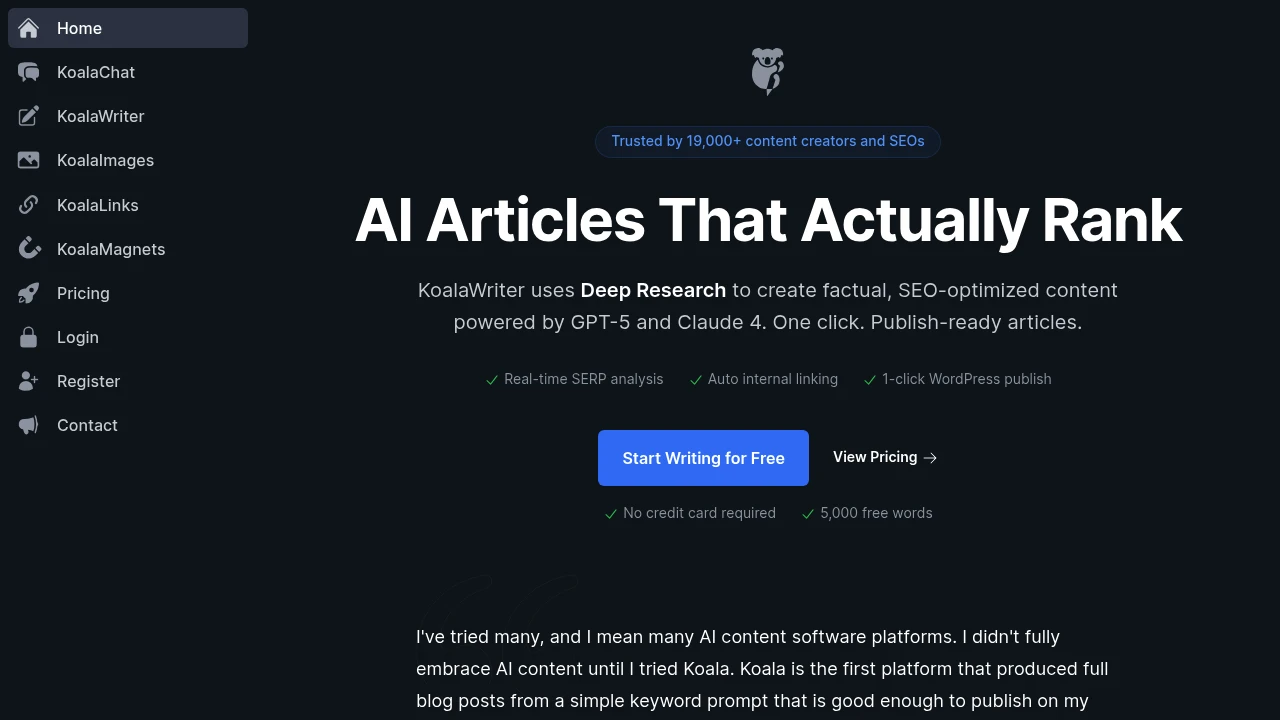
Koala AI offers KoalaWriter and KoalaChat, using GPT-5 and Claude 4 with deep research to create publish-ready SEO articles. Auto internal linking and 1-click WordPress publish.
Summary
Koala AI is an AI writing platform built for SEO content creators, using deep research to generate factual, SEO-optimized long-form articles that solve content scaling and ranking challenges.
What is Koala AI?
Koala AI provides KoalaWriter and KoalaChat. KoalaWriter uses GPT-5 and Claude 4 models with real-time SERP analysis to generate structured, publish-ready long-form articles from a single keyword prompt. The system auto-handles heading tags, internal linking, and supports one-click publishing to WordPress.
Core Capabilities
- Deep Research: Ingests reliable sources to create factual content
- Real-time SERP analysis: Optimizes structure and topical coverage based on search results
- Auto internal linking: Intelligently builds site links to boost SEO
- 1-click WordPress publish: Publish directly to your site without manual copy-paste
- Multiple article types: Supports product roundups, local places, informational content
Pros
- One-click publish-ready articles save significant editing time
- Content depth and structure outperform most AI writing tools
- Real-time SERP analysis ensures topical relevance and ranking potential
- Starts at $9/month with 5,000 free trial words
- Continuous feature updates with responsive developer support
Cons
- Still requires professional editing to ensure expert-level accuracy
- Output quality depends on LLM training data limitations
- Primarily optimized for English content; other language support unclear
- Requires SEO knowledge to fully leverage tool capabilities
Decision Guidance
Use when: You need to scale SEO content production as a publisher, niche site operator, or content marketing team—especially if you have an editorial process to quickly review AI drafts.
Consider alternatives: If you need highly specialized or technical content, strict brand voice requirements, or primarily create non-English content, pair with human writers or choose specialized writing services.
Looking for alternatives to other popular services? Check out other posts in the alternatives series and GTM Guide, a directory of tools with filters for tags and alternatives for easy browsing and discovery.

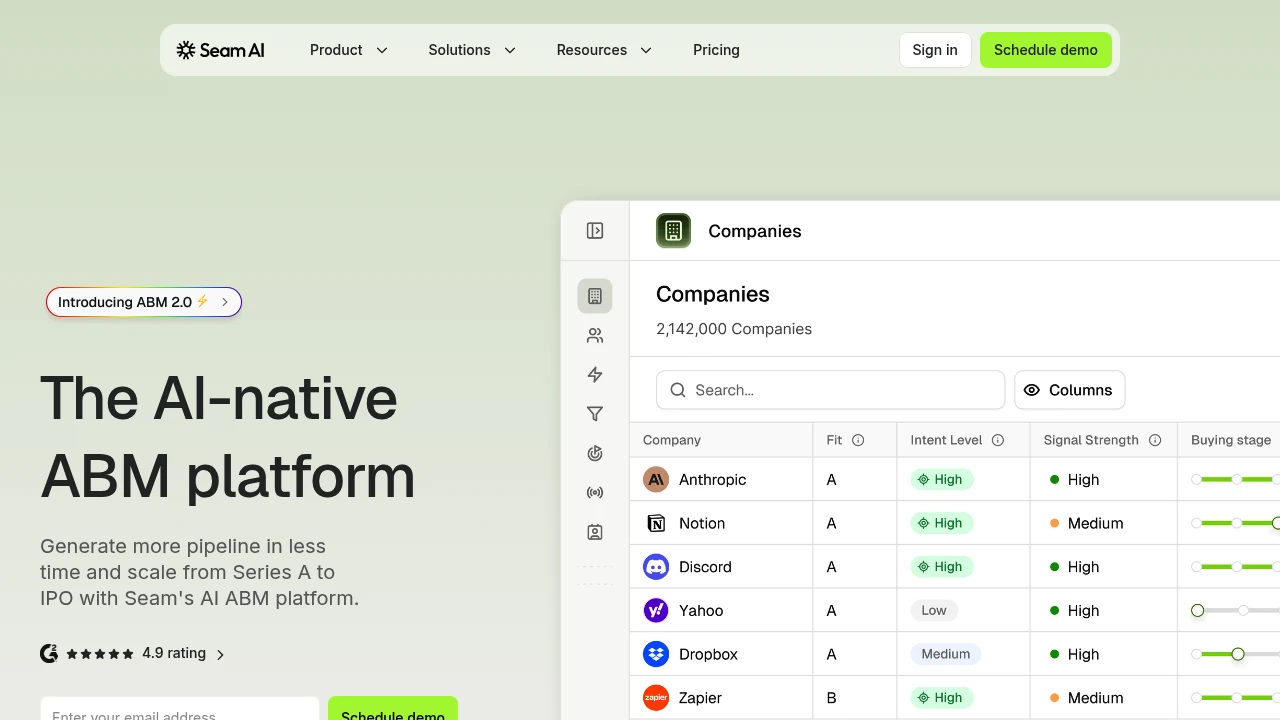
AI-native ABM platform that automates account research, monitors company and person-level intent signals, executes multichannel campaigns, and tracks end-to-end ROI and real pipeline.
Summary
Seam AI is an AI-native account-based marketing (ABM) platform that uses AI agents to automate account research, monitor intent signals, and execute multichannel campaigns while tracking real pipeline directly in your CRM.
What is Seam AI?
Seam AI replaces legacy ABM platforms with AI agents that validate ideal customer profile (ICP) fit, analyze tech stack and team structure, monitor first- and third-party intent signals, and coordinate email, ads, and SDR outreach. The platform provides end-to-end reporting that shows which plays generate pipeline, with native integrations to your existing tools.
Core Capabilities
- AI account research: Agents analyze firmographics, tech stack, team structure, and custom data points to validate ICP fit
- Company and person-level intent monitoring: Track dozens of first- and third-party intent signals to identify active decision-makers and research topics
- Multichannel campaign execution: Coordinate email, ads, and SDR outreach with blended human and automated touchpoints triggered by real-time signals
- End-to-end ROI tracking: Automated reporting shows which plays generate pipeline and trace directly to closed deals
- Native integrations: Works with your existing CRM and marketing stack without rebuilding infrastructure
Pros
- AI agents automate account research and ICP validation, drastically reducing manual prospecting time
- 4x faster campaign launches with pipeline traceable to closed deals
- Real-time intent signals provide full context so SDRs talk to buyers showing active intent
- End-to-end reporting clearly shows ROI for fast strategy optimization
- Deploy ABM without rebuilding your entire tech stack
Cons
- Pricing not publicly available; requires contacting sales
- Primarily targets B2B SaaS and growth-stage teams; may be overkill for small businesses
- Relies on third-party data sources for intent signal quality
- Learning curve may require marketing operations support
- No free trial or self-service signup option mentioned
Decision Guidance
Use Seam AI when: You're a marketing, sales development, or operations team at a B2B SaaS or growth-stage company that needs to automate ABM workflows, track real pipeline to closed deals, and launch campaigns quickly without rebuilding your tech stack.
Consider alternatives when: You're a small team or have limited budget and need a self-service platform or free trial; your ABM needs are simple and existing tools suffice; or you require fully custom intent data sources rather than relying on third-party vendors.

ZoomInfo is an AI-powered GTM platform with 350M+ B2B contacts, buying signals, org charts, and sales automation to help you find decision-makers, boost conversions, and expand accounts.
Summary
ZoomInfo is an AI-powered GTM platform that combines B2B data, buying signals, and sales automation to help sales, marketing, and RevOps teams quickly find decision-makers, boost conversions, and expand accounts.
What is ZoomInfo?
ZoomInfo is an all-in-one GTM execution system for B2B companies, combining the world's largest business contact database, real-time buying intent signals, org charts, and AI automation tools. The platform uses machine learning and generative AI (like Copilot) to analyze millions of companies and contacts, automatically prioritize high-value accounts, identify multi-threaded buying committees, trigger personalized outreach workflows, and integrate seamlessly with Salesforce, HubSpot, Outreach, and other CRM and sales tools—giving teams a single source of truth.
Core Capabilities
- B2B database: 350M+ contacts and company profiles with job titles, tech stacks, revenue, and more
- Buying intent signals: Real-time tracking of funding, hiring, tech changes, executive moves, and other triggers
- AI Copilot: Auto-generates account summaries, outreach emails, meeting prep notes, and next-best actions
- Org charts: Shows decision-makers, influencers, and complete buying committee structures
- Data enrichment & sync: Automatically updates contact and company records in CRM and marketing platforms
- Sales automation: Auto-routes leads based on account fit, territory, and buying stage
- Multi-channel outreach: Integrates email, phone, LinkedIn, and ad targeting
- Account scoring: AI evaluates conversion likelihood and prioritizes high-value opportunities
Pros
- Broad, accurate data: 350M contacts, verified and updated in real time, GDPR and CCPA compliant
- AI-driven insights: Copilot auto-identifies buying signals, generates personalized content, saves 11+ hours/week
- Deep integrations: Seamless connections with Salesforce, HubSpot, Outreach, Salesloft, Marketo, and more
- Multi-team support: Built for SDRs, account executives, RevOps, marketing, and recruiting teams
- Proven results: Customer cases show 40% more closed deals, 4× pipeline growth, 10% higher response rates
Cons
- Opaque pricing: Contact sales for quotes; can be costly for small businesses
- Learning curve: Feature-rich platform takes time for new users to master
- Credit-based access: Contact data extraction limited by subscription plan quotas
- Data coverage gaps: Smaller companies or certain regions may have less complete records
- Integration dependency: Requires CRM and sales tools to unlock full value
Decision Guidance
When to use: B2B companies need large-scale prospecting, account-based marketing (ABM), fast identification of decision-makers and buying committees, automated data enrichment and outreach workflows, or want to unify sales and marketing teams around a single data source. Ideal for SDRs, account executives, RevOps, and demand generation teams.
When to consider alternatives: Small teams with limited budgets, companies serving primarily local or non-English markets, those needing only basic contact data without AI automation, or organizations with robust internal data systems that don't require external enrichment may prefer lighter or region-specific tools.

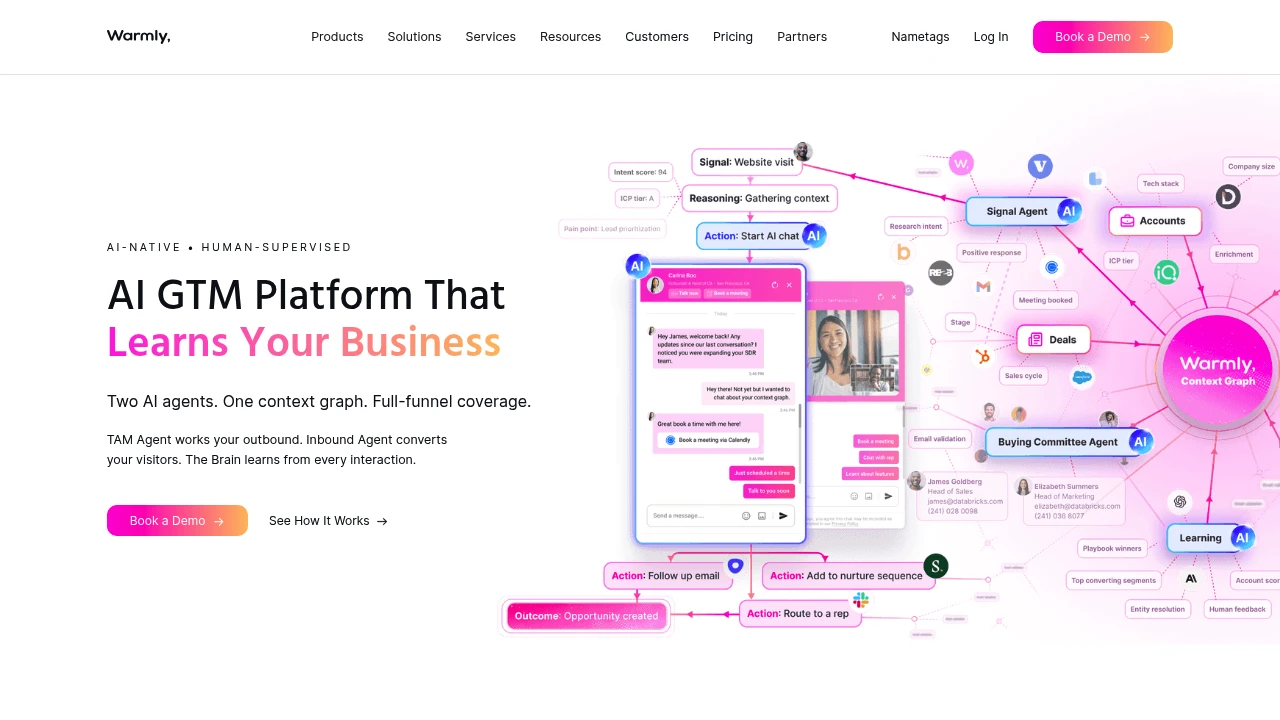
Warmly AI offers dual AI agents that auto-identify website visitors, track person-level intent signals, execute outbound and inbound conversion, helping GTM teams build real pipeline.
Warmly AI - Person-Level Intent Platform
Warmly AI is an AI-native GTM execution platform that automates outbound and inbound conversion through dual AI agents and a context graph, helping sales and marketing teams identify visitors, track real-time intent signals, and engage automatically.
What is Warmly AI?
Warmly AI is a full-funnel AI GTM platform combining TAM Agent (outbound) and Inbound Agent (visitor conversion) as two autonomous agents. The core is The Brain, a context graph that learns from every interaction, auto-scores accounts, maps buying committees, tracks cross-channel signals (1st-party web behavior, 2nd-party social activity, 3rd-party keyword research), and executes coordinated email, ads, chat, and personalized microsites. Ideal for GTM teams looking to cut CAC, accelerate first meetings, and build pipeline from website visitors.
Core Capabilities
- Dual AI agents: TAM Agent handles outbound (account scoring, buying committee mapping, coordinated email & ads); Inbound Agent converts visitors (person-level ID, AI chat, smart popups, personalized microsites)
- The Brain context graph: Learns from all interactions, provides full account history and intent context
- Real-time person-level intent signals: Integrates 1st-party (web behavior, product usage, CRM), 2nd-party (social activity, job changes), 3rd-party (keywords, competitor research) data
- Omnichannel execution: Automates email, ad retargeting, AI chat, LinkedIn outreach
- Visitor de-anonymization: Identifies personal identity and company info of website visitors
Pros
- Full-funnel coverage: Single platform integrates outbound and inbound, replaces multiple point solutions
- Real-time conversion: Auto-identifies high-intent visitors and engages instantly, accelerates meeting booking
- Contextual intelligence: The Brain provides full account history, avoids duplicate or irrelevant outreach
- Cost-effective: Users report saving tens of thousands annually (vs. Drift etc.), CAC cut ~50%
- Fast results: Case studies show 5 meetings booked within weeks of onboarding
Cons
- Depends on web traffic: Inbound Agent effectiveness tied to existing visitor volume; low-traffic sites see limited benefit
- Learning curve: Dual agents and context graph require initial setup and data integration
- Pricing transparency low: No public pricing on website; requires sales contact
- 3rd-party data limits: Intent signal accuracy depends on external data source quality
- Emerging platform: Compared to mature tools, feature iteration and integration ecosystem still developing
Decision Guidance
Use Warmly AI if: Your GTM team wants to build pipeline from website visitors, needs automated outbound and inbound conversion, and wants to replace multiple tools (like Drift, Clearbit, Outreach) with one platform to cut costs. Especially suited for B2B SaaS or high-growth companies with steady web traffic who value real-time engagement and intent signals.
Consider alternatives if: Your website traffic is extremely low or you rely mainly on offline channels; you need highly customized workflows and your existing tool stack is deeply integrated; you prefer transparent pricing and mature ecosystems (like HubSpot, Salesforce).

DemandScience combines verified buyer signals, multi-channel orchestration, data management, and expert optimization to help B2B teams convert marketing into measurable pipeline without adding platforms.
Summary
DemandScience is a B2B marketing services platform that combines verified data, multi-channel execution, and expert support to help businesses convert content into actual sales pipeline while avoiding phantom signals and tool sprawl.
What is DemandScience?
DemandScience delivers Precision Performance Marketing as a Service, integrating buyer intelligence, content resonance analysis, automated orchestration, and AI optimization. The platform covers demand generation, advertising, data management, email outreach, event execution, and content production, letting marketing teams focus on pipeline growth without managing additional MarTech tools.
Core Capabilities
- Verified Buyer Signals: Real buyer readiness data with full provenance tracking
- Multi-Channel Orchestration: Automated execution across ads, email, web, and events
- Data Management: Cleanse, enrich, and activate B2B contact data
- Content Studio: Creative design, translation, and content production services
- AI Visibility: Optimize content for discovery by humans and AI search engines
- Continuous Optimization: Expert teams and AI improve performance each cycle
Pros
- Verified buyer signals reduce phantom leads; ad fraud rate just 3% (vs 20% industry average)
- Integrated service model eliminates need for new MarTech platforms, lowering overhead
- Client cases show 417% pipeline boost and 39% shorter sales cycles
- Complete service portfolio from demand generation to event execution
- Expert + AI collaboration provides ongoing optimization support
Cons
- Service model requires reliance on external team, less internal control
- Pricing and service scope not public; requires consultation for evaluation
- Best suited for mid-to-large B2B enterprises; may be costly for small teams
- Integrating with existing MarTech stack may require workflow adjustments
- Results depend on data quality and target market characteristics
Decision Guidance
When to use: B2B enterprises need verified buyer data, multi-channel execution, and expert support while reducing tool management burden to focus on pipeline growth. Ideal for teams with content assets but low conversion or facing phantom signal issues.
Consider alternatives: Teams preferring full control over marketing execution, those with mature MarTech stacks and in-house experts, or budget-constrained small businesses may find point solutions or self-built processes more suitable.

AdRoll ABM combines account-based marketing with multi-channel advertising. AI buyer insights, real-time signal tracking, and automation help you reach decision-makers, accelerate high-value deals, and deliver 5X ROI.
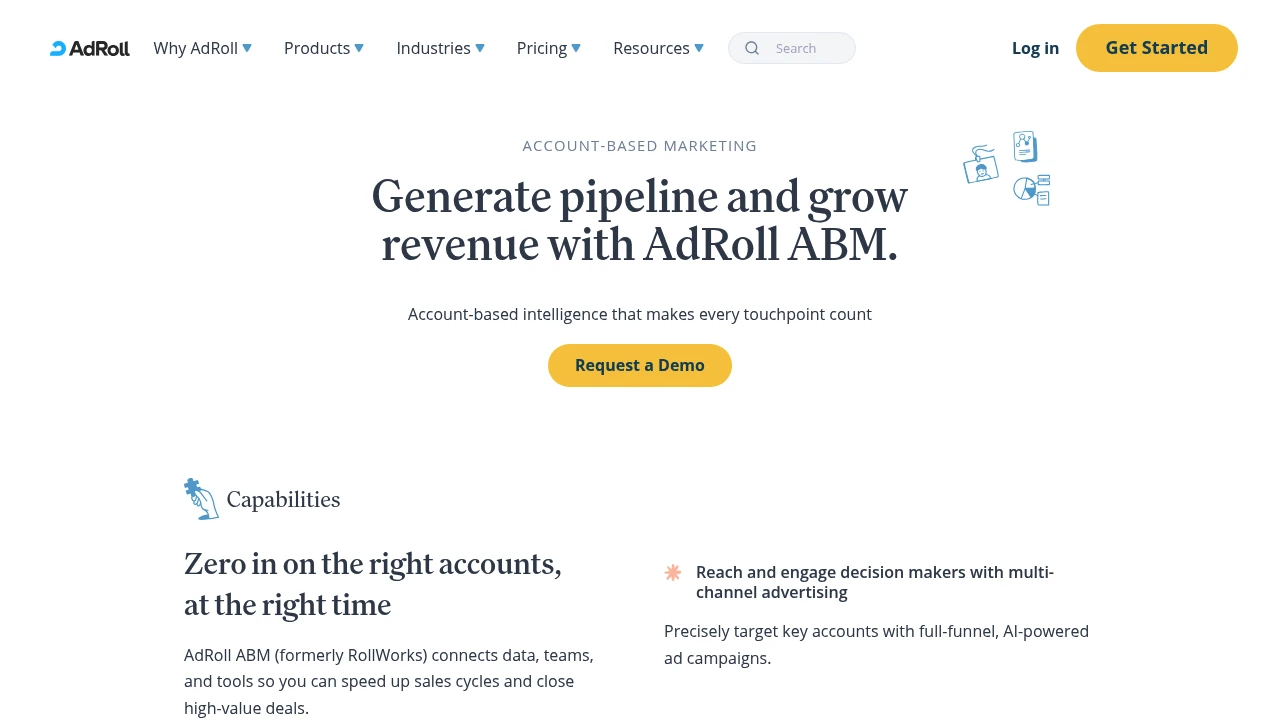
AdRoll ABM Directory Review
AdRoll ABM (formerly RollWorks) is a B2B account-based marketing (ABM) platform that unifies buyer insights, multi-channel advertising, and sales collaboration tools to help businesses target high-value accounts, shorten sales cycles, and increase close rates.
What is AdRoll ABM?
AdRoll ABM integrates precise B2B audience segmentation with a cross-channel demand-side platform (DSP) in a single application. Powered by InIQ AI buyer insight engine and BidIQ bid optimization engine, the platform is built on 2.6 billion digital identities and 92 million contacts. It automatically defines ideal customer profiles (ICP), identifies potential target accounts, and tracks buyer signals in real time to recommend next actions. Marketing and sales teams can execute personalized ads and outreach across websites, apps, social media, and streaming services using integrated CRM data.
Core Capabilities
- AI buyer insights: Automatically identify high-fit accounts and capture buying signals early
- Real-time signal tracking: Command Center monitors buyer behavior and recommends CRM updates or contact list creation
- Multi-channel ad execution: Deploy personalized full-funnel campaigns across web, social, and streaming platforms
- Sales and marketing alignment: Integrate data platforms to keep team strategies synchronized
- ROI tracking and attribution: Measure performance from buyer journey to closed revenue
Pros
- Precise targeting: AI engine auto-filters high-value accounts, reducing manual research time
- Multi-channel reach: Manage cross-channel ads and outreach from one platform
- Proven results: Case studies show 16% average opportunity increase; Snowflake achieved 50% new opportunity rate
- Real-time action prompts: Buyer signals trigger automated workflows for faster response
- 5X ROI: Official data shows superior return compared to other ABM platforms
Cons
- Learning curve: Integrating multiple AI features and CRM requires initial setup and training
- Pricing transparency: Detailed pricing not public; requires sales contact for quotes
- SMB fit: Feature depth and data scale better suited for mid-to-large B2B enterprises
- Integration dependency: Best results require deep integration with existing CRM and marketing tools
Decision Guidance
When to use: B2B enterprises executing account-based marketing strategies, shortening high-value deal cycles, or needing to unify marketing and sales data for better conversion rates will benefit from AdRoll ABM's automation and insight tools.
Consider alternatives: Smaller businesses with limited budgets or those needing basic CRM functionality rather than advanced ABM strategies may prefer lower-cost marketing automation tools or single-channel advertising platforms.
Looking for alternatives to other popular services? Check out other posts in the alternatives series and GTM Guide, a directory of tools with filters for tags and alternatives for easy browsing and discovery.

Demandbase is a B2B ABM platform that integrates first- and third-party data, uses AI to identify buying groups, and automates marketing and sales workflows to boost pipeline velocity.
Demandbase Review
Demandbase is an account-based marketing (ABM) platform for B2B enterprises, unifying data, AI insights, and automated execution to help sales and marketing teams identify buying groups and accelerate pipeline conversion.
What is Demandbase?
Demandbase merges first-party CRM and web activity with third-party intent data into a unified account view. Its AI agents (Agentbase) automate signal detection and orchestrate cross-channel actions. The platform offers account identification, web personalization, B2B ad targeting, sales tools, and analytics—focusing on buying groups rather than individual contacts, ideal for enterprise sales requiring multiple decision-makers.
Core Capabilities
- Buying group identification: Integrates account, contact, and buying group data to reveal full decision teams
- Intent data & signal integration: Combines first-party behavior and third-party intent signals for real-time purchase detection
- AI-driven automation: Pipeline AI triggers marketing and sales workflows automatically
- Native B2B ad platform (DSP): Intent-based, hyper-targeted ad delivery
- Web personalization & orchestration: Dynamically adjusts content and messaging by account stage
- Tech stack integrations: APIs and native connectors for CRM, marketing automation, and sales engagement platforms
Pros
- Unified data view: Consolidates multi-source data into a single account truth, reducing silos
- Transparent AI logic: Shows reasoning behind recommendations, not a black box
- Buying group focus: Targets decision teams, not individuals, improving enterprise close rates
- Native ad DSP: No external ad platform needed; intent data drives targeting directly
- Flexible integration: Open APIs and bi-directional data flow fit existing tech stacks
Cons
- Steep learning curve: Feature-rich platform takes time to master; may overwhelm smaller teams
- Pricing not public: Requires sales contact for quotes, lacks transparency
- Depends on data quality: Incomplete first-party data reduces AI accuracy
- Enterprise-focused: May exceed budget or needs for SMBs
- Integration needs tech resources: Complex setups may require dev team support
Decision Guidance
When to use: Enterprise B2B companies needing unified sales and marketing data, targeting multi-stakeholder decision processes, and deep integration with mature CRM and marketing automation systems. Customer cases show 3× conversion lift and 83% faster pipeline velocity.
Consider alternatives: Smaller teams with limited budgets, simple sales cycles, or basic lead management needs may prefer HubSpot, 6sense, or ZoomInfo. If you lack dedicated marketing ops staff, build data foundations first before adopting.

Common Room integrates 50+ data sources to capture buying signals with AI agents, identify anonymous visitors, and automate personalized outreach for GTM teams.
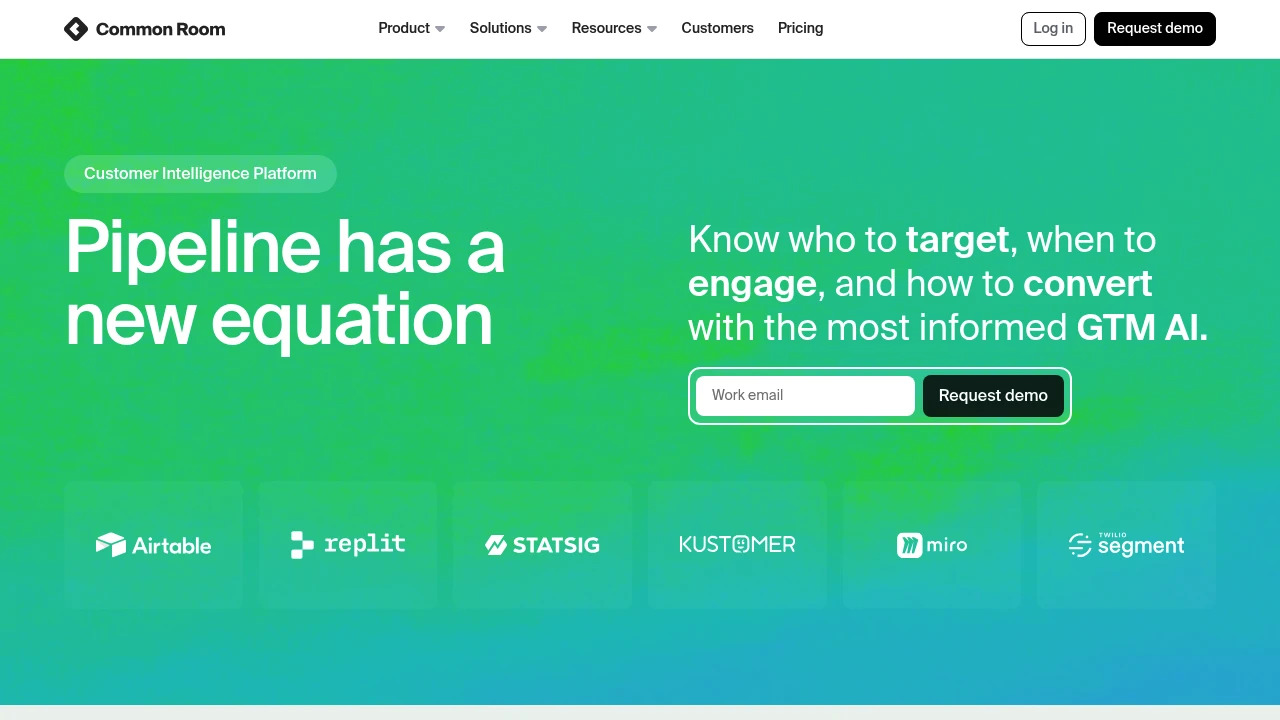
Summary
Common Room is a customer intelligence platform that helps GTM teams identify targets, time engagement, and boost conversions. AI agents automatically capture buying signals, turn anonymous visitors into known prospects, and automate personalized outreach.
What is Common Room?
Common Room delivers the most informed GTM AI for sales and marketing teams. The platform integrates 50+ data sources, uses RoomieAI™ Capture to continuously monitor buying signals, employs Person360™ for identity resolution and enrichment, and leverages RoomieAI™ Activate to automate outreach personalization. It unifies fragmented customer interaction data into actionable intelligence, showing teams who to contact, when to reach out, and how to convert.
Core Capabilities
- RoomieAI™ Capture: AI agent automatically hunts and captures buying signals across 50+ native integrations
- Person360™: AI-powered waterfall enrichment and identity resolution engine that turns anonymous signals into known buyers
- RoomieAI™ Activate: Auto-generates personalized outreach messages using buying signal context
- Unified customer journey: Integrates complete user interaction history into a single view
- Workflow automation: Rep-friendly command center that automates outbound plays
Pros
- Integrates 50+ data sources for the most comprehensive buying signal coverage on the market
- Person360™ delivers industry-leading enrichment match rates
- AI agents automate signal capture and message personalization, reducing manual work
- Built for enterprise scale, supports hundreds of reps and millions of prospects
- Replaces multiple point solutions (signal tools, enrichment, AI SDRs, ABM)
Cons
- Pricing not publicly available, requires sales contact
- Learning curve may be steep with multiple AI agent features to master
- Small to mid-size teams may not need such comprehensive functionality
- Dependent on third-party data source integration quality
Decision Guidance
Use Common Room when: Your GTM team needs to integrate multiple data sources, automate prospect identification and outreach, and manage large volumes of prospects. Especially suited for enterprise teams looking to consolidate multiple point solutions.
Consider alternatives when: You're a small team with limited budget, or only need a single capability like enrichment or signal monitoring. Specialized tools may be more cost-effective for narrow use cases.

Cognism delivers phone-verified B2B contact data and buyer signals focused on Europe, with built-in GDPR compliance to help sales teams increase connect rates and build pipeline fast.
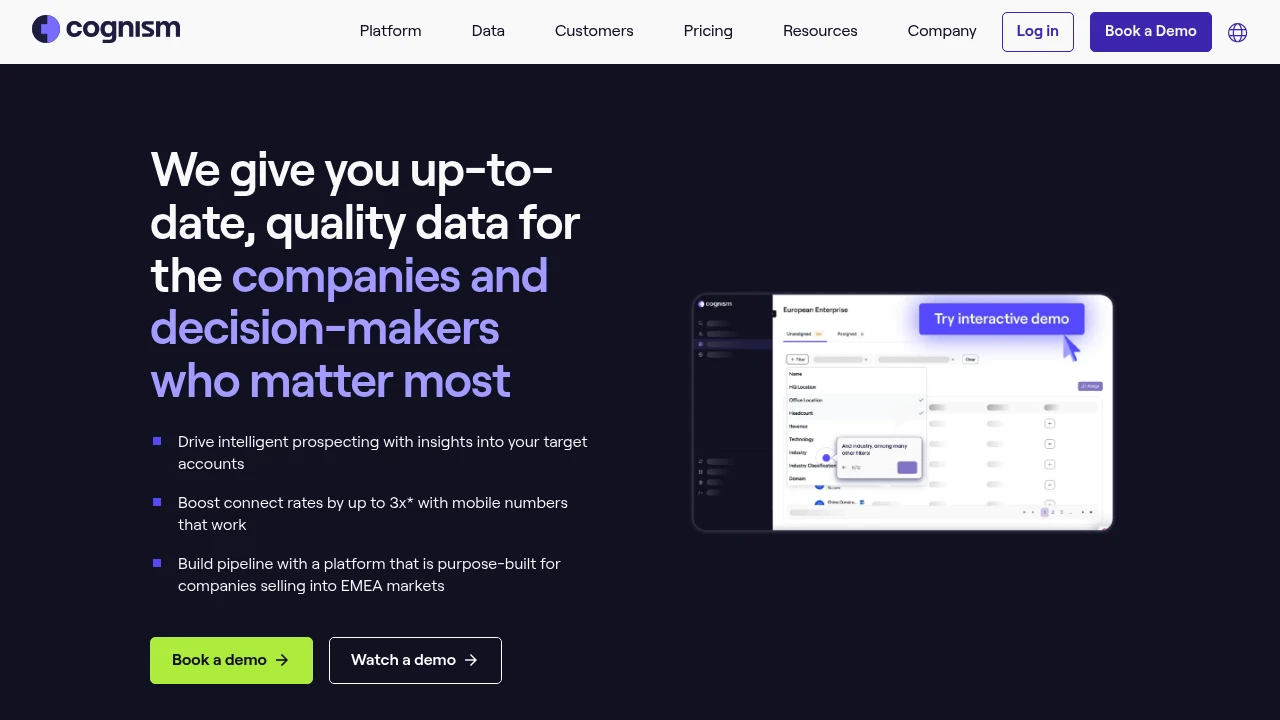
Summary
Cognism is a premium sales intelligence platform focused on European markets, offering verified B2B contact data and buyer signals to help sales teams boost connect rates and build compliant prospect lists.
What is Cognism?
Cognism provides quality B2B contact data for sales and revenue teams, with a strong focus on the UK and EMEA markets. The platform delivers phone-verified Diamond Data® mobile numbers, decision-maker emails, buyer intent signals, and technographic data, with built-in GDPR and CCPA compliance. Over 4,000 businesses use Cognism to reduce research time, improve dial efficiency, and reach senior decision-makers.
Core Capabilities
- Diamond Data®: Team-verified mobile numbers to reduce wasted dials
- European coverage: Deep B2B contact data across UK and EMEA regions
- Signal Data: Buyer signals including hiring trends, funding rounds, and technographics
- Sales Companion: AI-powered lead recommendations and account summaries
- Data-as-a-Service: Integrate data into CRM and data warehouses via API or batch delivery
- Compliance: Built-in GDPR/CCPA alignment and Do-Not-Call list checks
- CRM integrations: Seamless connections to Salesforce, HubSpot, Pipedrive, and more
Pros
- Leading contact data coverage and accuracy for European markets
- Verified mobile numbers significantly boost connect rates (customers report up to 3x improvement)
- Built-in compliance features suitable for regulated industries
- Strong decision-maker data (VP-level and above)
- Native integrations with major CRMs and sales tools
Cons
- Pricing not publicly transparent; requires contacting sales
- Primary strength in EMEA; coverage may be weaker in other regions
- May be costly for small teams or budget-conscious startups
- Learning curve to adapt to full product suite
- Some features (like Signal Data) require additional setup
Decision Guidance
Use Cognism when: Your sales team targets B2B customers primarily in the UK or EMEA, you need verified decision-maker contacts and compliant data, and you want to improve outbound connect rates and meeting bookings.
Consider alternatives when: You operate mainly in North America or APAC, have limited budget, or only need basic contact data without phone verification and buyer signal features.

Clearbit is HubSpot's native data provider, offering B2B data enrichment, lead scoring, routing, and visitor intent identification to focus on high-value opportunities.
Summary
Clearbit is HubSpot's native B2B data provider, using AI to enrich lead and account records, deliver real-time scoring, routing, and buyer intent identification, solving incomplete data and lead prioritization challenges.
What is Clearbit?
Clearbit has joined HubSpot as the first native data provider. It combines public web data, proprietary datasets, and large language models to transform unstructured information into standardized B2B data. Teams can enrich every lead, contact, and account record, and use IP intelligence to identify buying intent from anonymous website visitors.
Core Capabilities
- Record enrichment: Global coverage to auto-populate lead, contact, and account data
- Real-time scoring & routing: Score and assign leads based on industry, corporate hierarchy, normalized role, and seniority
- Buyer intent identification: Turn anonymous website traffic into qualified opportunity signals matching your ideal customer profile
- Form shortening: Collect only email addresses, auto-enrich other fields to reduce friction
- Standardized categorization: 6-digit NAICS, GICS, SIC industry codes and corporate hierarchy structures
Pros
- Native HubSpot integration eliminates need for additional tools
- AI-driven data standardization improves accuracy and coverage
- Real-time lead scoring and routing accelerates response times
- IP intelligence uncovers hidden opportunities from anonymous visitors
- Dynamic form shortening boosts conversion while ensuring data completeness
Cons
- HubSpot-only availability, no support for other CRM platforms
- Pricing not publicly disclosed, requires sales contact
- Data accuracy depends on public sources and AI models, potential for errors
- Global coverage may be limited in certain regions
Decision Guidance
When to use: Your team runs on HubSpot and needs automated data enrichment, real-time lead scoring, or website visitor intent identification—especially B2B sales and marketing teams wanting to focus on high-fit opportunities.
Consider alternatives: You use Salesforce, Pipedrive, or other CRMs, or need standalone data enrichment tools with transparent pricing.

6sense is a B2B predictive intelligence platform that uses AI to identify buyer intent, optimize marketing and sales strategies, and boost conversion rates.
6sense
6sense is a B2B predictive intelligence platform that helps companies identify prospects actively researching their products, optimize marketing and sales workflows, and drive revenue growth.
What is 6sense?
6sense uses AI and big data analytics to track anonymous buyer behavior, predict purchase intent, and enable marketing and sales teams to engage high-value prospects at the right moment. The platform integrates multi-channel data to deliver account-level insights, helping B2B organizations shorten sales cycles and improve close rates.
Core Capabilities
- Buyer intent data: Track anonymous research behavior and identify demand signals
- Predictive analytics: AI scores account likelihood and timing to purchase
- Account prioritization: Automatically flag high-value target accounts
- Multi-channel orchestration: Personalize interactions across ads, email, and web
- Sales intelligence: Real-time alerts on key account activity
Pros
- Discover potential buyers early and gain competitive advantage
- AI-driven account prioritization boosts team efficiency
- Unified view of marketing and sales data
- Shortens sales cycles and increases conversion rates
- Supports enterprise-scale ABM strategies
Cons
- High cost creates budget pressure for SMBs
- Requires sufficient data volume to deliver value
- Steep learning curve and need for dedicated management
- Some features depend on third-party data sources
- Initial setup and integration can be time-intensive
Decision Guidance
Best for: B2B enterprises running account-based marketing (ABM) that need to predict buyer intent, optimize high-value customer acquisition, and have adequate budget and data infrastructure.
Consider alternatives: Smaller businesses with limited budgets, shorter sales cycles, or smaller customer bases may find better value in lower-cost CRM or marketing automation tools.


